Monday, 22 November 2010

'New Art Now'- Nein Danke

Miao Xiaochun 'ORBIT' at BMAG

I popped into Birmingham Museum and Art Gallery today in anticipation of enjoying their ‘New Art Now’ exhibition of recent acquisitions of contemporary art, Drawn in by the Fiona Rae painting on the flyer, the exhibition seemed promising with apparently a more international range of artists’ work to get away supposedly from much of the so-called ‘regionalism’ of the collection.

What a disappointing and dull experience it proved to be. I actually like many of the artists on display, yet found the whole hanging and feel of the show very uninspiring. It just seemed very flat and boring, lacking variety although there was a diverse range of work. It just all seemed to have a ‘cool’ and detached feel, with much of the work possessing an obsession with formalism that kept me at arm’s length.

The Fiona Rae piece was not her best, with just not enough of the dynamism and formal inventive energy that I love in much of her work. There was a Jason Martin piece that seemed really dated already somehow, although I hate things to be defined on those terms. I love George Shaw’s and Callum Innes’s paintings usually too, but I felt there work lacked their usual power in this context.

The international work was represented by the German printmaker, Christaine Baumgartner, and Chinese artist, Miao Xiaochun. Baumgartner’s giant woodcuts were based on video stills of reflections in the Birmingham canals. I didn’t enjoy these, either as images, or as depictions of water, lacking the visual complexity of their subject. The monumental photograph by Miao Xiaochun, one of China’s leasing artists, was apparently inspired by the flattened perspective to be found in Chinese scroll paintings, where the artist had manipulated his photograph of a Chinese bus station to create a similar effect, where all the elements existed on the same perspective plane across the picture. To be honest the effect was so subtle as it made me wonder why he bothered, and I can’t but help finding manipulated photographs like this more and more boring. I never really liked them. The image itself was surprisingly just not that interesting to engage you more fully either, with or without the photo trickery.

I think galleries like BMAG play an important role in supporting our regional artists and exposing their work to visitors from outside the area. The ‘How Art Is Made’ gallery at BMAG showcases some excellent artworks by some of the regions artists. I would hate to see this neglected in favour of these recent acquisitions which really failed to impress this visitor today. I felt really let down, particularly as I helped to pay for these pieces.

Tuesday, 16 November 2010

Late November

David Gunnings

I enjoyed a drive in the late afternoon on Sunday through the Worcestershire countryside. The light glowed through the trees and across the land. The landscape has now turned to yellow ochre’s, burnt umber browns and earthy greens as the previously glorious autumnal colours have faded, signaling the beginning of winter. My son was dozing in the back of the car, and Midlake were on the stereo. I love the thinking space that driving allows.

I’ve been trying to process some of the very different exhibitions I’ve seen lately, and some of the work I’ve been trying to make. At Bilston Craft Gallery I really enjoyed an exhibition of etchings and etching plates by Bilston born artist, David Gunnings. The exhibition spanned thirty years of this artist’s career and his experience of depicting the disappearing manufacturing landscape of the Black Country and beyond to Ironbridge. Developed from drawings completed entirely on location, the etchings had a terrific quality of mark and line that seemed to move and unearth the scene. Although I liked the Black Country scenes, particularly the ones actually inside former factories and forge mills, I was most drawn to his etchings of the ancient standing stones sites of Britain. I love the images, but also Gunning’s obsession with traveling across Britain to discover and draw all the sites he could. The excitement of traveling to far flung corners of the UK, sketchbook in hand, never knowing what you may find must be a real thrill. For an hour there, I really wanted to be David Gunnings.


David Gunnings

Last Wednesday I attended the Private View of celebrated Magnum photographer Martin Parr’s exhibition of over 600 photographs he has taken of the Black Country in the last year at The Public, West Bromwich. Parr is very well known and respected and it has been a real coup for the region to commission him to work here, largely based in West Bromwich, and managed by Multistory, who I too have been lucky enough to work with. He also worked with the HNC photography students at Sandwell College, mentoring and helping them with their own work, a selection of which was shown alongside Parr’s in an exhibition called ‘Show Me A Secret’.

Martin Parr

The Private View was very busy, and it was great to see The Public finally drawing in large numbers of people. I must admit I was a little underwhelmed by Parr’s photographs though. The installation of over 600 was a bit much to take in, but there was an edited and more curated exhibition of some of the photos upstairs,which seemed to make more of a statement. I ended up preferring some of the works in the student show, which seemed to possess an edge that was missing in Parr’s work. He’s not a photographer that’s really known for having an ‘edge’ though in that sense, but as someone who grew up in West Brom and know the Black Country well the region does possess this: it is a tough place to live, and I would have liked to see more of this reflected in the work. Perhaps he isn’t the artist to do this.

Interestingly, the next day I visited the exhibition ‘Art and The Uncanny’ at The Waterhall Gallery in Birmingham which featured some nocturnal photographs by Black Country born Richard Billingham of the backs of houses and quiet, neglected spaces in Cradley Heath. I’d seen these reproduced before and found them a bit boring if I’m honest, but seeing them again and in the flesh (they were large pieces), and with the Parr exhibition in my mind, they seemed to have that edge and power that maybe I was looking for at The Public. They had an unsettling air and atmosphere that related more to my experience of the Black Country. Context can be everything.


Richard Billingham

I really enjoyed the rest of the exhibition, which had a great mix of photography, painting, print and sculpture from artist’s based in or associated with the West Midlands. It was a real shame it was only for a brief, blink and you’ll miss it, four days. A wasted opportunity, in my view, to showcase some of the best practice in the region.

I completed a new painting late last night. I was surprised how it turned out, and I’m not sure what I think of it. But of course, one wants to be surprised. With the act of painting it can often snatch control from your hands and tell you it might be more interesting to try this! We’ll see when I go down to the studio tonight to clear up and assess the damage…

Sunday, 31 October 2010

Sunshine On Leith

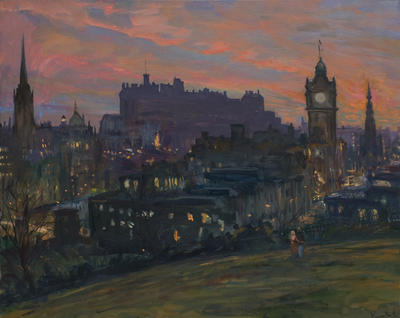
Henry Kondracki, 'Edinburgh Lovers', oil on canvas

I’ve just returned from a holiday in Edinburgh. I saw some great painting in the small commercial galleries dotted around Dundas Street in the New Town area of the city. I really loved an exhibition of paintings by Henry Kondracki at the Scottish Gallery. They had a real directness and honesty, with some terrific handling of oil paint. I haven’t been so excited about a painting exhibition in a long time. His atmospheric Edinburgh landscapes really moved me and took me back to the time I used to live and have a studio there between 1996-1999.

I love the city, and it will always have a special place in my heart as it is where I met my wife, Diane. I met lots of interesting artists and friends in the studio I was based in Gorgie in the West End. Many of them are doing really well now earning a living through their art. It always struck me that many of the students that left places like Edinburgh College of Art had a different attitude to their English counterparts, one of taking their craft more seriously in becoming professional artists and seeking out the many opportunities to be found in the commercial galleries in Edinburgh and Glasgow. The quality of work I saw was inspiring, but also depressed me when I thought of how little serious commercial galleries we have in Birmingham. What do we have? Number Nine? Come on…please!

Anyway, here are a few examples of work and links to a few of the artists and friends I was lucky enough to work alongside then…

www.robertmaclaurin.com/
www.strathearn-gallery.com
www.openeyegallery.co.uk


Robert Maclaurin, 'Early Morning, Howqua River'.
oil on linen, 196 x 165cms, 2005

Donald Provan, 'Lochside', oil on panel, 90 x 120cms

Donald Provan, 'Blue Shoal', oil on metal, 45 x 70cms

Chris Bushe, 'Shimmering Light, Loch Roag', oil on canvasboard, 16 x 14 inches
Matthew Draper, 'Foggy Evening', pastel on paper, 45 x 90cms

Scottish art and literature has been an enduring influence on my own work and life ever since I was a student on Foundation Course years ago and discovered the work of artists such as Ken Currie and Peter Howson. It would be good to discuss this further in a future blog…

Thursday, 28 October 2010

Turning Japanese...

Kitagawe Utamaro, 'Three Beauties', woodblock print

I went to see the Utamaro exhibition at the Ikon Gallery in Birmingham the other day. It blew my mind. I know the work well in reproduction, but seeing them for real was something else. The scale of them and the uniformity of the installation of what was a really substantial number of prints struck me as being so powerful and perfect. It was the best show I’ve seen in a long while.

Julian Opie

The influence of the Japanese woodblock artists has of course been a huge influence on Western painting from the Impressionists onwards in the late nineteenth century. It still exerts a powerful influence on more contemporary painters such as Alex Katz, Elizabeth Peyton and Julian Opie, who has co-curated an exhibition of Hiroshige’s prints at Ikon, and also created some recent portrait works that have been a sort of dialogue with Utamaro’s portraits.

Shaun Morris, 'Audience', oil on canvas, 240 x 450cms

Utamaro’s portraits have also been an influence on my own portrait paintings. I love the generalized treatment of form that is then juxtaposed with the most convincing and nuanced observations of gesture. I looked at these qualities a lot in my ‘Audience’ commission at JCC, as well as the deceptively simple, but inventive compositional elements he uses. I don’t think I could ever come anywhere near to the brilliance of his work, but it always remains very inspiring.

Tuesday, 19 October 2010

Talkin' Priming Yet Another Canvas To Sit In The Studio Gathering Dust Blues

I’ve been priming a canvas in preparation for a painting. I’ve stretched and primed hundreds of canvasses over the years, and I never really enjoy this part of the process. I just find it boring. I’m impatient and just want to get on with painting. Yet the fact that this part takes time is probably good for me. It allows me the time to think more carefully about the painting I’m about to embark upon. The primer is the first paint that goes onto the canvas, and priming is particularly useful in giving me a feel for the scale of the painting and an insight into how I might approach it. Once primed and ready however, I do love the blank, white canvas and that exciting feeling of anticipation before starting the painting.

I read in his journals that Keith Haring often used to paint a border first within the edges of his canvasses for a similar reason; to sort of mark out and feel the arena where the ‘action’ of his painting would take place. He created nearly all of his paintings completely spontaneously which I find remarkable. I love Haring’s work. The sheer energy within it and behind it is always so inspiring. Those journals are a great read too.

Keith Haring 'Untitled'

Some artists are obsessed with priming. I once attended a lecture by painter Bernard Cohen where he talked about the joy he had in priming his huge canvasses twenty times or more, sanding between each coat. Many painters apparently do this to achieve the perfect ‘surface’. I wondered what I was missing, but also how they afforded it. The most I have primed is about six coats, and I must say I found it made little difference. I’ve experimented a lot with primers over the years, and have come to the simple conclusion that with good gesso double priming is perfectly fine, which is what I was taught on degree in the first place! Some artists on a budget also use a mixture of emulsion and PVA to make their own primer, but this is a bad idea. Emulsion is meant to be used on hard surfaces like walls or wood, not flexible ones like canvas. In time it will turn brittle and your painting is likely to flake and peel off. David Hockney famously experimented with emulsions in the sixties and many of his paintings from that period have deteriorated already. I’m getting a bit technical here so I’ll finish. I might find it boring, but good preparation is important.

Bernard Cohen 'Untitled'

I bought Bob Dylan’s latest in the Bootleg Series today, ‘The Witmark Demos 1962-64’. They sound brilliant. Their unfinished, and often sketchy quality, reminded me of all the preparation and rehearsing that goes into things before the finished product of the official recording (though Bob fans will know how much he dislikes most of his official recordings). There are some comparisons to be drawn here with painting. This can also be seen with the way the preparation, or demos in Dylan’s case, can contain more vigour and spark than the final piece. Catching the thing can often be a disappointment after the chase.


Sunday, 3 October 2010

The Last Picture Show...

I spent an interesting morning in West Bromwich last Friday, as I took down my paintings from the empty shop units that I’ve been exhibiting them in for the last two months as part of Sandwell Arts 'Art In Empty Spaces' project.

The town is in desperate need of regeneration, and indeed there is a great deal of activity to support this. I’ve enjoyed exhibiting my work, and even if I say so myself, I don’t think the portraits looked half bad. Sadly though, my intention to change some of the portraits around during the exhibition never materialized for one reason or another.


I lined up all the paintings along the shopping arcade for a few photos, as I thought that this might be the last opportunity I ever have to see all the paintings together again.


I was commissioned to paint 25, and eventually made over 30. One was sold when they were first shown, and I’ve also taken a couple off the stretchers which I felt weren’t as successful in retrospect. Looking at all of the remaining ones now in these photos, it still seems like a pretty substantial body of work. I can’t ever imagine being presented with an opportunity like this commission again.

Monday, 27 September 2010

'The night's synthetic half-light rolls over your steering wheel...'

Jock McFadyen, 'Roman Road'

There’s a pile of books knee deep at the side of my bed as usual. I often only seem to have time to read when I go to bed. But lately I’m enjoying lots of different books on painting and different painters that is seeping into my consciousness in the studio. I thought it might be interesting to share a few current things…

Jock McFadyen and Greyhound

I’ve admired Jock’s paintings for years, but have particularly enjoyed his urban landscapes since he has removed the figure and just concentrated on ‘portraits’ of the buildings. I love his palette. It has always spoken volumes to me about my own urban experience growing up in places like West Bromwich…

I’m continuing to be fascinated by Rackstraw Downes’ miniaturist-like landscapes of America’s armpits and wastelands. I love the paintings and how he can transform a landfill site into a thing of great beauty in paint, but I’m particularly fascinated by how he works entirely on location from direct observation, without any reliance on photography. He can spend months at a site. I find it a really appealing approach I’d love to be able to adopt.

Fairfield Porter, 'Beach', 1952

I love the spare compositions and restraint of feeling in Fairfield Porter’s work. I think the light and treatment of form is terrific. I feel that all the elements seems to coalesce with a great clarity that really moves me.

Brice Marden, 'Cold Mountain' series

These huge paintings by Brice Marden above, inspired by Chinese calligraphy are fascinating, particularly the process by which they are made. The drawing is carried out with charcoal and brush on long sticks, then worked over and revised. I’ve been inspired to look for long sticks of my own already to develop some of my drawings of natural forms in a similar way…

Morris Louis, 'Untitled', 1961

I’ve also been enjoying looking at Morris Louis’ enormous abstract paintings from the 1950’s and 60’s. The gestural mark making and processes involved in the creation of these great works, combined with Louis’ striking combinations of colour still seem very contemporary.

Byron Kim, 'Synedoche'

The book ‘Monet and Modernism’ has also been an interesting read, featuring many other Abstract Expressionist painters like Louis and second generation Abstract Expressionist painters from America and Europe. It explores their relationship with the great French painter and shows both the diversity of his influence, and has introduced me to some previously unknown painters such as Byron Kim (above).

The title for the blog comes from a track, 'Home', on the Villagers album 'Becoming A Jackal', which I'm loving at the moment too...