Showing posts with label The Black Country. Show all posts

Tuesday, 13 May 2014

Jack Dee on Desert Island Discs...

I listened with a great deal of interest to Jack Dee discussing his life on Radio Four’s ‘Desert Island Discs’ on Sunday. I love this show: the simple format of it, and the fascination it holds for me to just listen to people, from whatever walk of life they exist in, talk about their lives, which I also love. I found I had a great deal of empathy for certain key things he discussed, one of them being education and his experience at school, and how he just had a massive problem with just sitting in a classroom being asked to listen and write about stuff. This is something I now realise I have a problem with even now, and which emerged during my time at high school as I became increasingly bored and lost with what school was all about, what it could offer me and what I had to offer. I gradually got worse and only just scraped my O levels , and completely failed my A levels, lacking any motivation between the ages of 17 to 18 other than music, with art being the only subject I was remotely interested in. It was only when I started studying on a Foundation Course in Art and Design, having managed to secure a place based on my portfolio only (one of the reasons I failed my A levels-once I realised I didn’t need them anymore for the Foundation Course, I was gone), that this whole world of painting and art slowly opened up in front of me, and, with some key encouragement (a massively important thing!) I found a passion and a purpose. Ever since then, through two degrees and a long and disciplined painting practice, I have been a model student. 
 
'Factory', oil on canvas, 120 x 80cms, 2014
Despite now standing at the front of the class as a lecturer, I still feel very uncomfortable as a student in most situations that are more classroom based, such as the continued professional training sessions that one is expected to go to at work.  I’m truly terrible sometimes, easily reverting to my teenage self: sitting at the back if I can, out of the way, fidgeting uncomfortably: easily bored or distracted; daydreaming, reluctant to join in the group activities. I’m very aware of these feelings of education when I’m teaching, and work hard to subtly manage the students and the studio so they are all comfortable, which can cause me a headache at times when things get a bit chaotic, but I think that is all part of trying to deliver a creative subject. 
 i-Pad study
Dee also discussed how performing is not a problem in his life, but non-performing is. When he is not doing that, or working towards it, he feels completely deprived of something he needs. I completely understood this in relation to my painting, and it picks up on points I made in a recent blog post.  If you’re in any way creative you need an outlet, and as Dee further stated, ‘you ignore this at your peril. And it’s a pain’. It is a pain. And it can be a pain for those around you too, but it is just something you need to do. I’ve been thinking a lot about these issues lately, reflecting on the difficulties I encountered in Norway, and putting my family through that because of my painting. I found Jack Dee’s insights really affirming. 


Tuesday, 29 April 2014

RMX RMXD

oil on paper/canvas studies 
I got excited making these last night. They are an attempt to explore in paint my recent collages. I seemed to find my foot suddenly, and unexpectedly, nudged inside a door…

Monday, 28 April 2014

RMX

I completed this canvas with the paint left over from the painting in the previous post. It’s a view from heather covered hills leading up to the North Sea on the coast of Denmark. It’s my first painting of Scandinavia that I’m actually pleased with. The dark tones were quickly washed in in about ten minutes over a very colourful, and pretty dreadful, version of the scene on a canvas that had been sitting in the studio for over a year.  In simplifying it all it seemed to suddenly take shape and somehow speak to me.  
It’s very different from these other studies I’ve been working on in oil on paper, which are an attempt to develop further the language and ideas from the larger painting in the last post. I have a larger canvas stretched and ready to try it on a larger scale, but I’m not sure….these paintings almost seem like ‘Black Highway’ the Remix, although I quite like that idea.
I was out with my camera one of the evenings last week taking photographs of a large transport depot underneath the M5, which generated lots of new ideas.

Wednesday, 26 March 2014

Paper and Scissors and Glue

Collage, 15 x 20cms
At work I collect all the off-cut strips from the student’s paintings and prints trimmed off on the guillotine. I like the seemingly random marks and textures left behind, and scoop them up and throw them in a box, and occasionally encourage the students to use them in collage or by working on top of them. Lately, I’ve made a few collages myself from these, inspired by some sketchbook drawings I’ve been working on of factories overlooking the canal.   
Collage, 15 x 27cms
Collage, 27 x 15cms
The collaged strips of paper are generating some interesting ideas about representing some of the factories structural forms in a slightly more imaginative way.   

Wednesday, 8 January 2014

'Black Highway'

‘Black Highway’, my latest exhibition of paintings and drawings opens at Nuneaton Museum and Art Gallery on Saturday. After a rather fraught day delivering the work on Monday (loading the van up with big canvasses in howling wind bubble wrap flying down the street, painting still wet, van not big enough, needing then to make two journeys, then getting lost to Nuneaton! (terrible at directions!) and heading to Coventry, display walls not the same as gallery plan I was given so then having to re-plan, mirror-plating 33 pieces until the gallery closes at five), I’m now feeling like a huge weight has lifted from my shoulders. I’m not sure what I’ve achieved, but I was very pleased with how the paintings looked in the gallery space. I think it’s the best I’ve seen the earlier motorway paintings look. After laying everything out, the gallery has been hanging them over the last two days. I see the exhibition for the first time on the same day as everyone else, when I go along this Saturday when it opens.

At the top of the post is the rather cool flyer my talented friend, Chris Cowdrill, created for the exhibition. He’s currently working on an accompanying ‘catalogue’ that will be available at the exhibition too. Following is an introduction I’ve written for the exhibition: 

Black Highway
Recent Paintings by Shaun Morris

‘We arrived where we started and know it for the first time’
                                                                                                                TS Eliot

This exhibition represents paintings made over the last two years with the support of a research and development grant from Arts Council England. These are my first serious attempts, after many false starts and blind alleys, to explore landscape painting following many years of painting portraits and the figure. Despite the obvious absence of any figures in the paintings I hope that the human presence is even more felt than before, but this time it exists in you, the viewer, who finds yourself transported to the painted places before you. 
  
My original intention was to explore the so-called ‘edges’ of the landscape; the nowhere zones between city and countryside; the overlooked and hidden. I planned to work on location in many places in the Midlands; and even took myself to Scandinavia, to Norway and Denmark, to fulfill an ambition to make work overseas. Ironically all the paintings on display in this exhibition were made from a landscape I have known all my life, just five minutes from where I was born and grew up. It is the landscape underneath the M5 and M6 motorways that take you right over West Bromwich, and the canals and towpaths that weave below, precariously traversed at night. 
As a consequence of exploring these places I have known, and yet not known, all my life, the paintings found themselves containing many personal memories and feelings. The more recent paintings of the canal reflections also found themselves representing a more political dimension. This was provoked by the recent death of Margaret Thatcher, and the barely healed wounds it seemed to expose in the community I grew up in.  The Black Country has never recovered from the devastating effects her policies had on the industrial landscape and lives of the people there.  When I travel through it now, there is a sense of an abandoned, or ruined and forgotten, landscape, which possesses its own bleak beauty. 

If there is one lesson I have learned in the last two years, it is that you never have to look far for inspiration. It is all there to be found in your own backyard.

I’d like to thank the following people for their advice, support and generosity over the last two years:

Chris Cowdrill, Andrew Smith, Jamie and Mette Wallace-Christiansen, Danny Bird, Laura Gale, Angela Swan, Marian Edwards, Hugh Marwood, Rob Williams, Ben Allchurch, Andrew Tift, and especially my wife, Diane. Oh, and Bruce of course….

Shaun Morris, January 2014

Hope you can make it along…

Friday, 15 November 2013

by the way...

'Weird Nightmare' oil on canvas, 100x 120cms, 2011
 
‘That Black Country glow’ my Dad remarked at the weekend on seeing the orange sky in a recent small painting of the M5. Historically, at its industrial peak, that orange glow in the night sky from the foundries, has been well documented from people as diverse as Queen Victoria to Tolkien. It’s weird that I hadn’t thought about its own possible significance in any way before in my paintings of the post-industrial Black Country. That orange sky is a recurring motif. I’m glad that my Dad, Tipton born and bred, did though.
That orange sky fills a large part of the first painting that I did based on this landscape, ‘Weird Nightmare’, back in 2011, which was recently exhibited in Nottingham at The BoHunk Institute in ‘By The Way’. I’m pleased to say I sold it the other day.
Sian Stammers, photographer and curator of ‘By The Way’, is keen to develop the exhibition as an ongoing project and extend its reach into the West Midlands, with my help. This is exciting. I hope I can help.
The orange sky is absent, as are most things, from this new large painting I’ve just completed based on the post-industrial landscape of the Black Country. It’s not quite like anything I’ve made before. I was thinking about Giotto a lot when I made it, and listening to susuma yokota’s ‘Sakura’ album, and Harold Budd’s ‘Abandoned Cities’. I’m not sure if this is significant, but they are great records.


Friday, 15 March 2013

Outside...


I’m obsessed


with cambered tarmacs, concretes,


the washings of rain.


Roy Fisher, excerpt from his poem, ‘Wonders of Obligation’


 Despite all the work that went into my recent exhibition in Rugby, I’ve been very busy in the studio lately working on new things; playing and experimenting with the material I generated in Scandinavia last August.  Much of my thinking has been informed by the reading and other things I have been doing since January. This includes an anthology of Birmingham born poet, Roy Fisher, ‘The Long and Short Of It- Poems 1955-2010’, published by Bloodaxe Books,  which I’ve enjoyed spending some time with most days. Many of Fisher’s poems often detail his long walks through the scarred Staffordshire countryside, and his inventive prose is often punctuated by his descriptions of the sights and details he observes along the way.  One feels like you are walking alongside the him, in good company, and it reminds me a great deal of my own long walks along the Black Country canals that weave through and under West Bromwich, Wednesbury, Great Bridge and Tipton that I used to make when I was younger, and revisit now to paint and draw. I’m looking at things with a different, older and more purposeful eye now though, not with the lost reverie of youth, when any sense of purpose was unimportant.
Roy Fisher, poet
Fisher has long been seen as an ‘outsider’ in the UK poetry and literary establishment (he is also a Jazz musician), and gained early recognition in the US. Interestingly, it was because of the negative connotations for outsiders of "Birmingham" that the city's name did not once appear in Fisher’s early long poem City, which seems to sum up a lot of attitudes towards the second city that I’m sure all its residents have experienced from outsiders at some point. I know I have. But if you think that is bad, try telling people you come from the Black Country.  Especially to a Brummie! I’ve experienced that too, and my Dad, Tipton born and bred, holds a great deal of resentment towards Brummies even now, which is a common feeling in the Black Country. This stems from his experiences of working in factories alongside men from Birmingham in the 60’s, and constantly being talked at by the Birmingham workers  as if he was an idiot because of his thick accent, and being accused of nicking their tools, which the Birmingham workers would not share with their fellow workers from  across the Black Country border. Somehow, to come from the Black Country is to always be seen as ‘outside’.
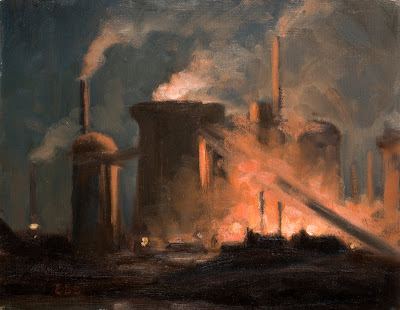
Edwin Butler Bayliss, 'Furnaces', 1920 approx
I felt I could sense some of this funnily enough in the paintings of Edwin Butler Bayliss that are currently on display at Wolverhampton Art Gallery. His paintings of the Black Country landscape at the height of its heavy industrial past, are all dark, tall chimneys and scudding smoke, and are being celebrated there in a major exhibition of this artist’s work.  Although I found much to enjoy in the paintings when I visited, I couldn’t help but feel they didn’t deserve this sort of attention, and were typical of this period of nineteenth century painting, owing more to France than Tipton. Bayliss was the son of a wealthy local factory owner, and for me the lack of any meaningful portrayal of the workers in these forges and furnaces, apart from a few anonymous figures seen from the back furtively moving across the landscape, who were more often than not working in the most appalling and dangerous conditions, was troubling. I guess his subject was the ravaged and melancholy Black Country landscape, but it served to create a somewhat disturbing ‘distance’ from the reality of the subject and the lives of the people working in Bayliss’s family factory. My own family, from my Dad and his brothers who all worked in factories like their Father, my grandad, and my grandmother’s brothers who all worked in the local mines,  they all worked in places like these and have dark tales to tell. These paintings stirred in me an uneasy sense of alienation.
Edwin Butler Bayliss, 'Evening In The Black Country', oil on canvas, 1920s

Alongside Bayliss’s works, in an adjoining room, were a selection of current interpretations of the Black Country by members of the RBSA. Please feel free to shoot me if I ever make anything like this in my portrayal of the edglands landscape. My A level students make more exciting work.


Slade in 'Flame'

I recently watched ‘Slade In Flame’, the 70’s movie starring the famous Black Country rockers, and despite it actually being filmed in Nottingham and Sheffield, I noticed  as the credits rolled up, it reminded me more of the industrial region that I grew up in. This was something to do with the black and dry gallows humor of Noddy Holder (who was great) and the band, and the other supporting cast that reminded me a great deal of the characters I grew up around that my Dad worked with. But what a bleak and dispiriting film it was too! It was an incredibly cynical tale of the perils and the reality of fame for a rock ‘n’ roll band in this era that left me quite numb as it rather abruptly ended, almost as if the filmmakers had become too jaded themselves to carry on with this story any longer than strictly necessary.   
                                                 Tom Thomson, 'Tamaracks', oil on board
I have also recently read ‘Painting Canada: Tom Thomson and The Group of Seven’, an extensive catalogue for the recent exhibition in 2011 of this group of painters at Dulwich Picture Gallery, which I sadly failed to get to. I opted for Richter at the Tate instead, but think I may have got more from the paintings of these guys, which are pretty new to me. I think it would be too much to describe their work as innovative or as important when compared to others of the period in Europe who they were greatly influenced by, such as the Post-Impressionists, the Expressionists and Munch, but I have really enjoyed the many strengths and qualities to be found in these often dynamic and colourful canvasses. Thomson’s small ‘plein air’ paintings have a special intense and dense quality that lifts them to another level, that I think is lost a little when they are developed into the studio pieces. I had a similar comment levelled about my own work at Rugby recently, which compared the energy in a smaller piece to a larger painting of the same motif where the person felt the energy had become ‘dissipated’. ‘Plein Air’ studies are always going to possess a certain quick, spontaneous energy by the very nature of how they are made.  Many people prefer Constable’s oil sketches for the same reason, and it was also commented on at the recent Thomas Fearnley exhibition at the Barber Institute, but the studio pieces are often something else entirely. But still, it is an issue I have been considering since the Rugby exhibition, but more in relation to scale, and have been working on many smaller pieces on the studio since in pastel and oil on paper.
                                                   Tom Thomson, 'Sunset', oil on canvas,
Coincidently, the Group Of Seven were greatly influenced by an exhibition of Contemporary Scandinavian Art held in New York in 1912, and shared an affinity with their ‘fondness for great, open spaces and the magic radiance of the arctic aurora’, and ‘an exhilarating sense of direct communication with nature and natural forces’. It is these qualities that I admire in the Groups’ work and their relationship with their native Canada, and need to share this with the wider world as they headed off on their various painting expeditions. Here is a good example by J.H McDonald in his ‘Beaver Dam’ painting of 1919. I also really like Lawren Harris’s stylised paintings of icebergs and mountains, which in their stylization possess an austerity that I find appealing.
E H McDonald, 'Beaver Dam', oil on canvas
E H McDonald, 'Dam and Birches', oil on canvas
Lawren Harris, 'North Shore, Lake Superior'


current studio work Jan-Mar 2013

McDonald in writing of the exhibition of Scandinavian art and comparing them with the Group’s ideals wrote, ‘The painters began with nature rather than art’. My own responses to landscape with my recent motorway paintings have begun the other way around, they are more about art than nature. I’ve been trying to bring the two areas closer together with my own Scandinavian work.  

There seems to be an ‘outsider’ theme to this post, and that seems to be the theme that is emerging from my Scandinavian work as I start to get deeper into it. The experience we had in Norway, and the feelings of abandonment we felt, coloured the whole trip, and also left me questioning my relationships with people. As I’ve worked on these pieces in the last few months, I keep coming back to these issues and my own persistent sense of being an ‘outsider’…