Showing posts with label Scandinavian painting. Show all posts

Tuesday, 13 May 2014

Jack Dee on Desert Island Discs...

I listened with a great deal of interest to Jack Dee discussing his life on Radio Four’s ‘Desert Island Discs’ on Sunday. I love this show: the simple format of it, and the fascination it holds for me to just listen to people, from whatever walk of life they exist in, talk about their lives, which I also love. I found I had a great deal of empathy for certain key things he discussed, one of them being education and his experience at school, and how he just had a massive problem with just sitting in a classroom being asked to listen and write about stuff. This is something I now realise I have a problem with even now, and which emerged during my time at high school as I became increasingly bored and lost with what school was all about, what it could offer me and what I had to offer. I gradually got worse and only just scraped my O levels , and completely failed my A levels, lacking any motivation between the ages of 17 to 18 other than music, with art being the only subject I was remotely interested in. It was only when I started studying on a Foundation Course in Art and Design, having managed to secure a place based on my portfolio only (one of the reasons I failed my A levels-once I realised I didn’t need them anymore for the Foundation Course, I was gone), that this whole world of painting and art slowly opened up in front of me, and, with some key encouragement (a massively important thing!) I found a passion and a purpose. Ever since then, through two degrees and a long and disciplined painting practice, I have been a model student. 
 
'Factory', oil on canvas, 120 x 80cms, 2014
Despite now standing at the front of the class as a lecturer, I still feel very uncomfortable as a student in most situations that are more classroom based, such as the continued professional training sessions that one is expected to go to at work.  I’m truly terrible sometimes, easily reverting to my teenage self: sitting at the back if I can, out of the way, fidgeting uncomfortably: easily bored or distracted; daydreaming, reluctant to join in the group activities. I’m very aware of these feelings of education when I’m teaching, and work hard to subtly manage the students and the studio so they are all comfortable, which can cause me a headache at times when things get a bit chaotic, but I think that is all part of trying to deliver a creative subject. 
 i-Pad study
Dee also discussed how performing is not a problem in his life, but non-performing is. When he is not doing that, or working towards it, he feels completely deprived of something he needs. I completely understood this in relation to my painting, and it picks up on points I made in a recent blog post.  If you’re in any way creative you need an outlet, and as Dee further stated, ‘you ignore this at your peril. And it’s a pain’. It is a pain. And it can be a pain for those around you too, but it is just something you need to do. I’ve been thinking a lot about these issues lately, reflecting on the difficulties I encountered in Norway, and putting my family through that because of my painting. I found Jack Dee’s insights really affirming. 


Friday, 2 May 2014

'Ever Tried. Ever Failed. No Matter. Try Again. Fail Again. Fail Better'

I like to exhibit my work and try and communicate with an audience, but really it’s just the act of painting, or creating something, that drives me on. This seems much more so as I get older. I like thinking about something, and then developing it through drawings and studies and other things, and then trying to make a painting. When I’ve done that, I hopefully get to the point where I believe I’ve nailed it in some way, but usually by the next day I’m thinking about the next one. Let’s face it, most paintings I make are exhibited briefly and then are largely hidden away and rarely looked it after I’ve made them. I think these feelings of ambivalence are pretty normal for most artists. I think the gallery experience often feels like something you feel you should have to do, rather than something you want to do. With these feelings in mind, I’ve been painting over a few older paintings lately, or taking them off stretchers to reuse the frames for new work.
I completed this painting last night. It’s taken about a year to complete, but I finally completely re-painted it in about an hour. It just suddenly felt like the right time.

Monday, 28 April 2014

RMX

I completed this canvas with the paint left over from the painting in the previous post. It’s a view from heather covered hills leading up to the North Sea on the coast of Denmark. It’s my first painting of Scandinavia that I’m actually pleased with. The dark tones were quickly washed in in about ten minutes over a very colourful, and pretty dreadful, version of the scene on a canvas that had been sitting in the studio for over a year.  In simplifying it all it seemed to suddenly take shape and somehow speak to me.  
It’s very different from these other studies I’ve been working on in oil on paper, which are an attempt to develop further the language and ideas from the larger painting in the last post. I have a larger canvas stretched and ready to try it on a larger scale, but I’m not sure….these paintings almost seem like ‘Black Highway’ the Remix, although I quite like that idea.
I was out with my camera one of the evenings last week taking photographs of a large transport depot underneath the M5, which generated lots of new ideas.

Monday, 26 August 2013

Not Norway

oil on canvas, 170 x 170cms
-->
This isn’t Norway. This isn’t a painting of a forest. Those aren’t trees set against the dark background. They are in fact the reflections in a canal in Smethwick of the concrete columns that support the enormous motorway that roars above. The scene couldn’t feel further from Scandinavia, and yet, as soon as I finished this large canvas the other day after many hours work, I was immediately struck by how much it felt like the Norwegian forest I found myself in exactly a year ago this week, especially the long nights staring into the silent, dark spaces between the trees. So maybe this is my first major painting of Norway? Or Smethwick? Who knows?


In response to my last post where I discussed the enjoyment of working on a piece for much longer, over six weeks in fact, compared to the usual one day I take on a piece, I enjoyed working on this in one sustained effort so much the other day that I found myself reflecting once again on the approach that I have taken for the last ten years or so. These are hard won things. The deep level of concentration required and total immersion in the act of painting was such a fulfilling experience.


I showed my wife, Diane, a photograph of the painting later. She was not particularly impressed. She questioned why would she be interested in an image like this? Her words bought to mind a quote by Schopenhauer, via Ad Rienhardt, that:


‘Interest is of no interest in art’


I like this quote. This idea is one of the other key things I’ve been mining in my painting for the last ten years.  

Friday, 15 March 2013

Outside...


I’m obsessed


with cambered tarmacs, concretes,


the washings of rain.


Roy Fisher, excerpt from his poem, ‘Wonders of Obligation’


 Despite all the work that went into my recent exhibition in Rugby, I’ve been very busy in the studio lately working on new things; playing and experimenting with the material I generated in Scandinavia last August.  Much of my thinking has been informed by the reading and other things I have been doing since January. This includes an anthology of Birmingham born poet, Roy Fisher, ‘The Long and Short Of It- Poems 1955-2010’, published by Bloodaxe Books,  which I’ve enjoyed spending some time with most days. Many of Fisher’s poems often detail his long walks through the scarred Staffordshire countryside, and his inventive prose is often punctuated by his descriptions of the sights and details he observes along the way.  One feels like you are walking alongside the him, in good company, and it reminds me a great deal of my own long walks along the Black Country canals that weave through and under West Bromwich, Wednesbury, Great Bridge and Tipton that I used to make when I was younger, and revisit now to paint and draw. I’m looking at things with a different, older and more purposeful eye now though, not with the lost reverie of youth, when any sense of purpose was unimportant.
Roy Fisher, poet
Fisher has long been seen as an ‘outsider’ in the UK poetry and literary establishment (he is also a Jazz musician), and gained early recognition in the US. Interestingly, it was because of the negative connotations for outsiders of "Birmingham" that the city's name did not once appear in Fisher’s early long poem City, which seems to sum up a lot of attitudes towards the second city that I’m sure all its residents have experienced from outsiders at some point. I know I have. But if you think that is bad, try telling people you come from the Black Country.  Especially to a Brummie! I’ve experienced that too, and my Dad, Tipton born and bred, holds a great deal of resentment towards Brummies even now, which is a common feeling in the Black Country. This stems from his experiences of working in factories alongside men from Birmingham in the 60’s, and constantly being talked at by the Birmingham workers  as if he was an idiot because of his thick accent, and being accused of nicking their tools, which the Birmingham workers would not share with their fellow workers from  across the Black Country border. Somehow, to come from the Black Country is to always be seen as ‘outside’.
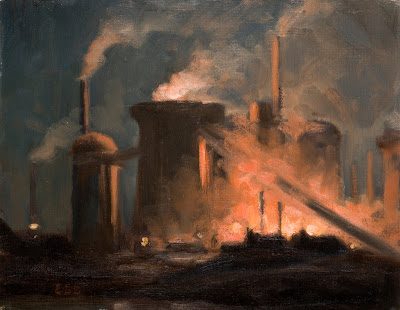
Edwin Butler Bayliss, 'Furnaces', 1920 approx
I felt I could sense some of this funnily enough in the paintings of Edwin Butler Bayliss that are currently on display at Wolverhampton Art Gallery. His paintings of the Black Country landscape at the height of its heavy industrial past, are all dark, tall chimneys and scudding smoke, and are being celebrated there in a major exhibition of this artist’s work.  Although I found much to enjoy in the paintings when I visited, I couldn’t help but feel they didn’t deserve this sort of attention, and were typical of this period of nineteenth century painting, owing more to France than Tipton. Bayliss was the son of a wealthy local factory owner, and for me the lack of any meaningful portrayal of the workers in these forges and furnaces, apart from a few anonymous figures seen from the back furtively moving across the landscape, who were more often than not working in the most appalling and dangerous conditions, was troubling. I guess his subject was the ravaged and melancholy Black Country landscape, but it served to create a somewhat disturbing ‘distance’ from the reality of the subject and the lives of the people working in Bayliss’s family factory. My own family, from my Dad and his brothers who all worked in factories like their Father, my grandad, and my grandmother’s brothers who all worked in the local mines,  they all worked in places like these and have dark tales to tell. These paintings stirred in me an uneasy sense of alienation.
Edwin Butler Bayliss, 'Evening In The Black Country', oil on canvas, 1920s

Alongside Bayliss’s works, in an adjoining room, were a selection of current interpretations of the Black Country by members of the RBSA. Please feel free to shoot me if I ever make anything like this in my portrayal of the edglands landscape. My A level students make more exciting work.


Slade in 'Flame'

I recently watched ‘Slade In Flame’, the 70’s movie starring the famous Black Country rockers, and despite it actually being filmed in Nottingham and Sheffield, I noticed  as the credits rolled up, it reminded me more of the industrial region that I grew up in. This was something to do with the black and dry gallows humor of Noddy Holder (who was great) and the band, and the other supporting cast that reminded me a great deal of the characters I grew up around that my Dad worked with. But what a bleak and dispiriting film it was too! It was an incredibly cynical tale of the perils and the reality of fame for a rock ‘n’ roll band in this era that left me quite numb as it rather abruptly ended, almost as if the filmmakers had become too jaded themselves to carry on with this story any longer than strictly necessary.   
                                                 Tom Thomson, 'Tamaracks', oil on board
I have also recently read ‘Painting Canada: Tom Thomson and The Group of Seven’, an extensive catalogue for the recent exhibition in 2011 of this group of painters at Dulwich Picture Gallery, which I sadly failed to get to. I opted for Richter at the Tate instead, but think I may have got more from the paintings of these guys, which are pretty new to me. I think it would be too much to describe their work as innovative or as important when compared to others of the period in Europe who they were greatly influenced by, such as the Post-Impressionists, the Expressionists and Munch, but I have really enjoyed the many strengths and qualities to be found in these often dynamic and colourful canvasses. Thomson’s small ‘plein air’ paintings have a special intense and dense quality that lifts them to another level, that I think is lost a little when they are developed into the studio pieces. I had a similar comment levelled about my own work at Rugby recently, which compared the energy in a smaller piece to a larger painting of the same motif where the person felt the energy had become ‘dissipated’. ‘Plein Air’ studies are always going to possess a certain quick, spontaneous energy by the very nature of how they are made.  Many people prefer Constable’s oil sketches for the same reason, and it was also commented on at the recent Thomas Fearnley exhibition at the Barber Institute, but the studio pieces are often something else entirely. But still, it is an issue I have been considering since the Rugby exhibition, but more in relation to scale, and have been working on many smaller pieces on the studio since in pastel and oil on paper.
                                                   Tom Thomson, 'Sunset', oil on canvas,
Coincidently, the Group Of Seven were greatly influenced by an exhibition of Contemporary Scandinavian Art held in New York in 1912, and shared an affinity with their ‘fondness for great, open spaces and the magic radiance of the arctic aurora’, and ‘an exhilarating sense of direct communication with nature and natural forces’. It is these qualities that I admire in the Groups’ work and their relationship with their native Canada, and need to share this with the wider world as they headed off on their various painting expeditions. Here is a good example by J.H McDonald in his ‘Beaver Dam’ painting of 1919. I also really like Lawren Harris’s stylised paintings of icebergs and mountains, which in their stylization possess an austerity that I find appealing.
E H McDonald, 'Beaver Dam', oil on canvas
E H McDonald, 'Dam and Birches', oil on canvas
Lawren Harris, 'North Shore, Lake Superior'


current studio work Jan-Mar 2013

McDonald in writing of the exhibition of Scandinavian art and comparing them with the Group’s ideals wrote, ‘The painters began with nature rather than art’. My own responses to landscape with my recent motorway paintings have begun the other way around, they are more about art than nature. I’ve been trying to bring the two areas closer together with my own Scandinavian work.  

There seems to be an ‘outsider’ theme to this post, and that seems to be the theme that is emerging from my Scandinavian work as I start to get deeper into it. The experience we had in Norway, and the feelings of abandonment we felt, coloured the whole trip, and also left me questioning my relationships with people. As I’ve worked on these pieces in the last few months, I keep coming back to these issues and my own persistent sense of being an ‘outsider’…


Tuesday, 18 December 2012

Mulled Whine...

'Catherine to Claire', Richard Diebenkorn
I’ve been mulling over lots of things lately with regards to my painting (I’m a good muller. Sometimes it is the only thing I can or have the time to do when the pressures of work and family take over). I’ve also seen a few good exhibitions, and been trying some new things.

One of these included a recent staff development in mixed media painting lead by artist Jenny Muncaster. I’m not very experienced in mixed media painting as it is something I’ve not had much interest in relation to my own work. Despite having a BA (Hons) and MA in Fine Art, Painting, like most artists much of what I’ve learned in the craft of my practice is self-taught and lead by my personal interests. Anyway, I really enjoyed the day and really found Jenny’s enthusiasm inspiring, and discovered lots of new techniques, which my students have been trying with great gusto ever since. It’s really opened up their work, and broadened my own delivery of teaching painting, which is what I was seeking.

So many artists/lecturer say you can’t ‘teach’ painting, meaning students either have it or they don’t, but I think this is a load of nonsense and history proves this. It’s just a lazy and unimaginative attitude to teaching. The more formal teaching I’ve received is the stuff that has carried me furthest, and this approach underlies much of my own work with students. It’s the poetry that is harder to teach.

Richard Diebenkorn
Much of the work with Jenny involved building up the surface of the painting using layers of paint and texture. I’ve enjoyed doing this too, and some of this is creeping up into some of my experiments in the studio as I begin to develop some of the work made in Scandinavia with greater conviction. Some of these are also influenced by the paintings of Richard Diebenkorn, who has appeared more seriously on my radar of influences lately. A recent visit to the studio by artist Hugh Marwood picked up on the shared ‘zones’ of colour (a major trait in Diebenkorn’s paintings, as well as the layered surfaces) and tonal banding in the motorway and Scandinavian paintings, which I found an encouraging connection. It’s helped me pick up and start to take these things on as a starting point. Liz Hawley, the arts consultant I’m currently working with, also commented last week that the Scandinavian paintings were also just as rooted in the edgelands, both geographically and psychologically, which I hadn’t been seeing. This feedback is great and spurs me on.


I went with Liz to see a small exhibition of painting at Nottingham Castle last week. The work was from the studios of local Nottingham painters, and had some great qualities and a serious engagement with the media on one hand, but much of the style and subject matter however, seemed to epitomize much of the concerns currently floating around: a deliberately off-handed, loose handling built on naïve illustrative drawing and lots of images of animals or creatures involved in some obscure narrative setting- a bit folk arty and a bit quirky. A bit predictable too. Still, it was good to see evidence of what appeared to be a more vibrant and collective painting scene than exists in Birmingham. 


'Labroffesson', Thomas Fearnley, oil on canvas, 1836

In November, I visited the Thomas Fearnley exhibition at the Barber Institute of Fine Arts. Fearnley was a Norwegian painter born 1802-1848, and toured Europe painting spectacular landscapes of the fjords, mountains, glaciers, forests of Scandinavia and Western Europe. It obviously had appeal because of my recent trip to Norway, but the exhibition also featured many of the ‘plein air’ studies painted by the artist. Much is made of the seeming ‘freshness’ of these in compared to the larger studio works, but I never see much point in this: of course they are fresher and contain a spontaneity simply because of the circumstances of their making. The studio works are a different beast altogether, and need to be if they are going to become their own thing. I liked the larger works: they contained a vigour and charge which seemed forged into a unique and individual vision. 


Thomas Fearnley
The same could be said of the Fiona Rae exhibition over at New Art Gallery, Walsall which I also enjoyed. Full of complex and playful formal ideas, these large scale and colourful paintings really celebrate the endless possibilities of painting as a continuing creative mode of expression. 

Fiona Rae, 'Untitled (Yellow), oil and acrylic on canvas, 1993
I’ve seen many exhibitions of Rae’s work over the years, and I must admit I prefer the qualities that seemed to exist in the earlier works, where the skidding and slipping marks seemed to possesses a less self-conscious autonomy, than the ones on display in Walsall which feel more deliberately constructed or ‘built’. There were two paintings though, a little smaller than the others and better for it, which seemed to have been over-worked, more heavily-laden with paint and surface, that tipped into a more uncomfortable, almost ugly state of being that I thought were much more interesting. Their scale seemed to confront you more at eye-level which I found unsettling and gave them a much more powerful presence in the room. I’m thinking a lot about scale at the moment….
'As I Run And Run Happiness Comes', Fiona Rae, oil and acrylic on canvas, 2009

I've been revisiting Counting Crows' 'August and Everything After' album lately. It's on heavy rotation at home, in the studio, and on the i-pod. With sublime songs like 'Round Here', 'Time and Time Again', 'Rain King', 'Sullivan Street', and well, all of them basically, it just seems the perfect record to lose myself in the last month or so...