Friday, 10 December 2010

'White Noise'...

As the Christmas shopping madness sweeps across the nation, I found myself caught in the blizzard of it all in Birmingham’s Bull Ring the other day. I’m not much of a shopper, like most blokes I just gravitate towards the record and bookstores and then a coffee shop for a rest, and find the whole experience exhausting and bewildering. In these situations I’m often reminded of a favourite passage in a favourite book, ‘White Noise’ by Don Delillo. It’s a brilliant read, that was recommended to me at Art College by one of my lecturers. I’ve since recommended it to students myself. I’ve copied some of the passage out below. It describes so well the modern shopping experience in our giant, homogenized malls, and how the central character is caught uncharacteristically up in it all…I really identify with it at this time of year.

‘The encounter put me in the mood to shop. I found the others and we walked across two parking lots to the main structure in the Mid-Village Hall, a ten-story building arranged around a center court of waterfalls, promenades and gardens. Babette and the kids followed me into the elevator, into the shops set laong the tiers, through the emporiums and department stores, puzzled but excited by my desire to buy. When I could not decide between two shirts, they encouraged me to buy both. When I said I was hungry, they fed me pretzels, beer, souvlaki. The two girls scouted ahead, spotting things they thought I might want or need, running back to get me, to clutch my arms, plead with me to follow. They were my guides to endless well-being. People swarmed through the boutiques and gourmet shops. Organ music rose from the great court. We smelled chocolate, popcorn, cologne; we smelled rugs and furs, hanging salamis and deathly vinyl. My family gloried in the event. I was one of them, shopping, at last. They gave me advice, badgered clerks on my behalf. I kept seeing myself unexpectedly in some reflecting surface. We moved from store to store, rejecting not only items in certain departments but whole stores, mammoth corporations that did not strike our fancy for one reason or another. There was always another store, three floors, eight floors, basement full of cheese graters and paring knives. I shopped with reckless abandon. I shopped for immediate needs and distant contingencies. I shopped for its own sake, looking and touching, inspecting merchandise I had no intention of buying, then buying it. I sent clerks into their fabric books and pattern books to search for elusive designs. I began to grow in value and self-regard. I filled myself out, found new aspects of myself, located a person I’d forgotten existed. Brightness settled around me. We crossed from furniture to men’s wear, walking through cosmetics. Our images appeared on mirrored columns, in glassware and chrome, on TV monitors in security rooms. I traded money for goods. The more money I spent, the less important it seemed. I was bigger than these sums. These sums poured off my skin like so much rain. These forms came back to me in the form of existential credit. I felt expansive…A band played Muzak. Voices rose ten stories from the gardens and promenades, a roar that echoed and swirled through the vast gallery, mixing with noises from the tiers, with shuffling feet and chiming bells, the hum of escalators, the sound of people eating, the human buzz of some vivid and happy transaction.’

Don Delillo,

‘White Noise’, 1985

I Am Angry...

I woke up feeling very depressed. It felt that the bill to lift the cap on student fees was always going to happen, but still it feels a shocking and a dreadful occurrence today as the reality of it all sinks in. I feel bewildered and devastated about it and the future implications it has for the country’s young people and their families, including my own son and the other children in my wider family.

If I hear one more time from Nick Clegg and Vince Cable that it is fairer than the existing system I will scream. How can raising fees from £3000 to £9000 be in any way fairer? They just bang on about their ‘improved and fairer system of repayment’, but the fundamental question remains: how can raising fees from £3000 to £9000 be in any way fairer? I’ve never sworn so much at the telly and the radio as I have in the last few weeks when they come on. I dread to think what my son’s first words will be…

Apparently those students whose families are on lower incomes who currently receive free school meals will receive the first two years tuition fees free. So that just leaves the remaining £9000 final years tuition fee payment to be made! The amount currently paid for all three years! The group that would ‘benefit’ from this is relatively small, and as usual it is those lower middle or middle income earners like myself that lose out and are not eligible for any benefits. And I thought the government was trying to create incentives for people to work. It is all so absurd, and could be seen as a bad joke if it wasn’t such an awful nightmare. How do Cable and Clegg sleep at night? How? They are a disgrace.

How do I look my students in the eye, and encourage them to strive for University places in subjects such as Fine Art? The way the government has cut by 100% the teaching funding, not the 80% often stated, from all Arts and Humanities and Social Sciences courses across the country including our top Universities such as Goldsmiths and The Slade tells me that they don’t want me to. Arts and Humanities? ‘Not good for the economy’. They want a market driven education model that just breeds the type of morons that appear on The Apprentice. The types of morons like themselves. What value do I have to my students as a Sixth Form lecturer teaching Art and Design? I feel sick with the thought of the future impact this will have on my teaching and my relationships in the classroom. That is of course if I have any future students with the proposed loss of EMA too. In the community I teach, I don’t think any of my students are not currently eligible for EMA. Most could not even countenance coming to college without this financial support.


And if I hear one more time the question asked by our blinkered media, ‘why should the tax-paying Lollipop lady down the road have to pay for your education?’ I will seriously hurt someone. Don’t we actually pay our taxes for such a thing as a good education? Education should be a right not a privilege. What happened to any feeling or vision of the greater good of our society and nation? What good is an uneducated country? A country that lacks heart and soul as courses and choices are eroded by a market-driven University system. What future do we want to create for the nation’s children and our society where they are saddled with mortgage-like debts for the rest of their lives? Weren’t these decisions made in the guise of paying off our huge debt?

I don’t think anyone is fooled that these are decisions are about cutbacks. The speed of these cuts and all the others, betray that these decisions are ideological ones, brought in by a sinister, but all too historically familiar, right-wing form of capitalism. The power tips back to the few as ever. The gains of society such as education return to the privileged. David Cameron’s ‘Big Society’ turns out to be a dismantling of the welfare state and any last bastion of society and fairness and hope that we were still trying to cling to.

So don’t question why the students were so angry. They have every right to be angry. We should all be angry. Yesterday was the bleakest political day in my life.

Wednesday, 8 December 2010

Whose Side Are You On...?


Ahead of the Commons vote tomorrow on lifting the cap on student fees, I’ve posted below an inspiring piece from the NUS. Responding to Deputy Prime Minister Nick Clegg's interview in this week’s Independent on Sunday, NUS has sent Nick Clegg a list of ten reasons why it is against his plans.

I’ve been wanting to write something about this issue and so many other things that this awful coalition government is doing to the country for weeks, but can never begin. I feel so angry and frightened about the sweeping idealogical changes that are happening in the guise of ‘paying off the deficit’, and how quickly they are doing them. I feel so passionately about education, and the piece below articulates the thoughts and feelings swimming around my head every day that I struggle to express. Whenever Nick Clegg appears on the news I want to put my foot through the telly.)

The response follows Clegg's failure earlier this week to respond to a letter from Aaron Porter, NUS President, in which Mr Porter set out his opposition to the Government's plans and requested an opportunity to discuss the issue with Nick Clegg in public.

Dear Nick

I see with interest that in today’s Independent on Sunday, you’ve challenged me to “come clean” about “just what my proposals are” for a graduate tax; asking for an “open contest” comparison. You will remember I wrote to you earlier in the week suggesting both a meeting and an open debate. Although I’ve had no reply other than reading your comments in a Sunday newspaper, I’m delighted to respond. Here’s ten reasons why I think our proposals are fairer and more progressive than yours.

Firstly, our proposal for a progressive graduate contribution scheme would have retained the idea that the state, as well as the individual, should contribute to the cost of Higher Education. Your Government’s decision to transfer the whole cost on to the individual through a loans system is the ideological choice of group who believe that Higher Education should only be available to the richest. I'm sure they are amazed at your willingness to go along with it and they’re not the only ones.

Secondly, under our proposals, earners in the lowest quintile would have paid less than £500 for university; those in the next quintile about half what they do now and those in the middle quintile roughly the same as now. It would only have been those who really benefit that would have paid more. Under your Government’s proposed scheme only the bottom 25% of earners would pay less overall- meaning 75% pay more. Our version of a graduate tax would have been more progressive.

Third, you’ve argued that your proposals are fairer because graduates would only start paying back when they earn £21,000 as opposed to £15,000 in our proposals drafted in 2008. You omit to mention that this is £21,000 in 2016 money, and that the threshold won't increase until 2021 (not even Vince Cable had worked this out when he spoke about it on the radio earlier this week). Under our proposals the repayment threshold would have moved every year in line with inflation.

Fourth, you say that your proposals are fairer because so many students never pay back their debt under your scheme. Being in debt for the next 30 years of our lives is not something we want to celebrate as progressive- and never paying off a debt is something I was raised to believe is a source of shame, not progressive pride.

Fifth, your proposed system introduces course price as a factor in student choice. Even if the system of loans and repayment makes it easier for a student to get into and then pay off debt (and I dispute your assertion that it does), there are still significant problems with a system that includes fees and course prices. It is ridiculous to assume that students won’t take the price of a course into account when choosing it, regardless of the repayment mechanism. A truly progressive system is one where students are able to make decisions according to their ambitions and aspirations without concern at all to price or potential returns (as remains the case in the proposed system), or viability in relation to the support they could obtain. A modified graduate tax would have removed price as a determinant in student choice.

Sixth, your system means that higher contributions go to rich institutions and lower ones to poor institutions. By operating a “fees and loans” scheme instead of graduate tax, it means that the higher payments from richer graduates end up flowing into the universities that are already richest, with the fewest poor students to support, the most endowment funds and the best asset bases. This means that, apart from the few on “golden ticket” scholarships, the poorest students go to the poorest institutions and the richest students end up topping up the richest institutions. There’s no sense in a progressive payment system if the outcome effects are regressive. Our modified graduate tax would have meant a fair distribution of the extra contributions that the richest graduates make to all universities.

Seventh, you have said you will look at “early repayment penalties” on loans (although we’ve had no detail yet). But this misses the point. By operating a fees and loans scheme, it is possible for the richest families to avoid taking out loans altogether- meaning that the children of (in your words) “Goldman Sachs Bankers” can avoid having to pay more at all. A modified graduate tax would have meant that those who financially benefit the most from their education pay their fair share in later life.

Eighth, your proposed system supposedly offers students more “consumer power”, helps drive university efficiency and improves quality. In truth your proposals offer virtually no enhanced rights or power to students over their provision. And there is no evidence from any other country that a market in Higher Education would work to improve efficiency- in fact most other countries’ evidence points to the opposite. There is also no evidence at all that the “market” improves quality or that there is any link between the quality of teaching and the price paid. The supposed “link” between a student paying an institution and it responding to student need is faulty, and a cover for an ideological attempt to marketise HE. Our modified graduate tax would not have pretended that students paying more automatically means they get more.

Ninth, the key determinant of university access is achievements at level 3. We wouldn’t have swapped £450m in maintenance support for the poorest at school and college doing A levels for a third of that in golden ticket partial scholarships to universities. What's the point in free first years for the poorest if they drop out of college before they get there?

But finally and tenth, your manifesto said you’d scrap fees. Your signed pledge said you’d vote against an increase. Your video address to my conference said you’d “vote against, campaign against any increase in that cap”. Your proposal takes student fees and debt and triples them. Ours would have taken fees and debt and abolished them.

Students are angry about your proposals because they are unfair, ideological and represent a massive betrayal of the students who voted for you. That is why they want your party to vote against them and not because “It’s great going on demos and really having a crack at the government of the day”.

Aaron Porter

NUS National President

PS- The vote on Thursday is a vote on the cap. It's not a vote on making fees progressive, or your scholarship fund, or reforms to deliver better value for students. Tripling fees before Christmas with a vague promise to make them more progressive after Christmas, on the thin excuse of prospectus deadlines, is nothing short of a disgrace.

Tuesday, 30 November 2010

'Immortality'- New Paintings by Ken Currie

Mars, oil on canvas, 210 x 300cms, 2008

As anyone who reads the blog will probably know I’m a big fan of Scottish painter Ken Currie, a contemporary of Peter Howson mentioned in the last entry. In the Eighties they were labeled as ‘The New Glasgow Boys’ with the late Stephen Campbell and Adrian Wiznieskei. His latest paintings are on show at Flowers East, New York, which may mean getting to view them may be a bit difficult, but the images on the Flowers website are well worth a look. I really like the way he has started to paint more convincing portraits. They seem less mannered and stylized than previous paintings. The gallery press release explains some of the motivations behind the work. I’ve cut and pasted some of it below…

Proud and Terrible King, oil on canvas, 167 x 137, 2009

“Dark and dramatic both physically and thematically, Immortality can be viewed as a meditation upon the nature of portraiture itself. While Ken Currie draws upon traditional portrait conventions, these figure paintings do not depict the likenesses of actual people. They are a presentation of an invented world of aristocrats, patrons, military and religious officials, and other esteemed persons who would traditionally be deemed “worthy” of being immortalized in a commissioned portrait.

Currie presents a kind of portraiture in which there are no holds barred, where the painter is not circumscribed by his own desire to flatter or his need for diplomacy. He shows a portraitist free to paint what he has actually seen or construed, and often reverses the process of accentuating the positive. In Currie’s hands, art collectors are depicted not as glossy, proud patrons of the arts, but anxious and vain in front of their acquisitions. A war “hero” sits astride a winded and thirsty horse. A suited man in a typical corporate headquarters-style pose is depicted without trousers.


Chimera, oil on canvas, 240 x 360cms, 2010

Immortality has a spirit of competition with the Spanish masters Currie so admires. Homage to Velázquez in particular can be seen in some of the works, including the large scale Chimera. In Chimera, the space is confusing and ambiguous - the viewer is unaware of his or her physical relationship with these figures: a cradle-to-grave collection of a family. As in Velázquez’s Las Meninas, the artist and the painting itself are found among this fictitious group. On the extreme right, one can see the left hand side of a canvas that is in fact the left hand side of the painting currently being viewed. Currie is shown scrutinizing his canvas, blade in hand, reminding the spectator that a painting is contingent - the painter can decide at any point to destroy what he has created. In another echo of Las Meninas, the artist seems to appear again as the backlit figure standing at an open doorway, looking past the cast of characters and out towards the viewer. Currie suggests the power of painting by creating something both rational and irrational, that exists and yet has no existence, that is real and yet a chimera.”

Follow the link to see more…the ambition of these two artists leave most of other contemporary painters in the shade

http://www.flowersgalleries.com/exhibitions/4043-immortality/

Sunday, 28 November 2010

'The Madness of Peter Howson'

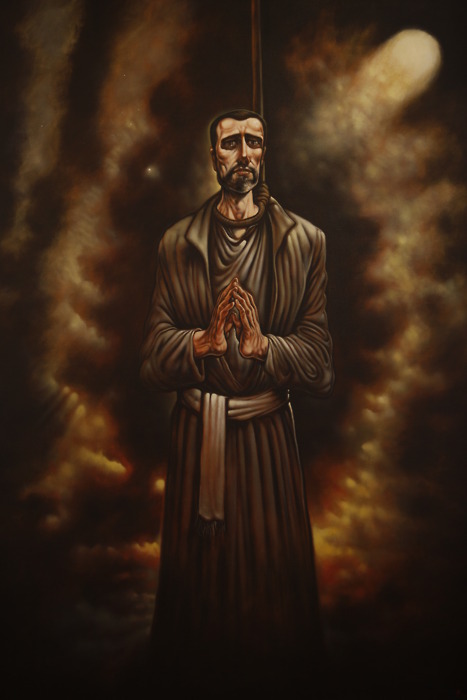
I found ‘The Madness Of Peter Howson’ on BBC Four the other night totally compelling viewing. It was a fascinating documentary that followed the famous Scottish artist as he struggled to complete an important commission for the Catholic church in Glasgow, depicting the martyrdom of Saint John Ogilvy.

He talked candidly on screen about his struggles with drink and drug addiction, money, Asperger’s Syndrome, and the devastating effect these things had had on his obviously fragile mental health. In recent years he has sobered up and become a born again Christian, yet the incredible compulsive drive and passion he demonstrated to make his dense, knotty, bold, and often eccentric figurative paintings just leaped off the screen. There was something of a caged, wounded animal about him as he padded restlessly about his home and studio. He even described himself as ‘a complete nutter’ at one point. I found myself thinking there was something pathetic about him, but also almost heroic. I was very moved, and couldn’t help but come away with a re-found admiration for this artist that I had previously lost.


Peter Howson 'The Heroic Dosser', 1987

I used to be a big fan of Howson’s art, particularly as a student. I learned so much about handling big scale figurative compositions from looking at his expressive paintings. They had a directness in their handling and energy I really admired, and gave me a lot of confidence in trying similar things in my own big paintings. I also loved their subject matter with their depictions of the Scottish working class, particularly the macho male world of Glasgow; a world of illegal boxing clubs and violent bars that Howson frequented. It was a far cry from the sedate and worthy depictions of the English working class to be found in Coldstream and Gore etc. I was really excited by his work as I was trying to attempt similar things about my own working class experience. Howson’s paintings were often shocking and brutal, and really unfashionable south of the border, which is never a bad thing and always appealed to me. I remember finally visiting the Gallowgate area of Glasgow where Howson had his studio, thinking it can’t be that bad. But it was. It was like a theatre of the world. It made me think Howson didn’t go far enough in his art.


But as time went on the work seemed to get more and more horribly mannered and repetitive. The brutish figures became much more parodies of their former selves and almost Marvel-like in their depictions of his muscle-bound anti-heroes. And when Jesus appeared on the streets of Glasgow, well….I was out of there. He seemed unable to move on, almost as if it was the money not the art that motivated him.


Peter Howson, 'The Martyrdom of Saint John Ogilvy', 2010

And I think there still is that side to the paintings he makes now. I really don’t like the way he depicts the figure with the huge distortions he makes to twisted limbs, swollen feet and monstrous hands. But the repetition, the sense that he just makes the same painting over and over again, I felt I did get closer to understanding through the film. His compulsive nature just drove him on and on, never satisfied, the figures a cipher for his troubled and turbulent emotional self, not really about Glasgow’s hard men anymore. They seemed more like the demons in his mind. It was very affecting, and made the work very powerful. He seemed lost in this chaotic world he had made. A brilliant documentary.

Monday, 22 November 2010

'New Art Now'- Nein Danke

Miao Xiaochun 'ORBIT' at BMAG

I popped into Birmingham Museum and Art Gallery today in anticipation of enjoying their ‘New Art Now’ exhibition of recent acquisitions of contemporary art, Drawn in by the Fiona Rae painting on the flyer, the exhibition seemed promising with apparently a more international range of artists’ work to get away supposedly from much of the so-called ‘regionalism’ of the collection.

What a disappointing and dull experience it proved to be. I actually like many of the artists on display, yet found the whole hanging and feel of the show very uninspiring. It just seemed very flat and boring, lacking variety although there was a diverse range of work. It just all seemed to have a ‘cool’ and detached feel, with much of the work possessing an obsession with formalism that kept me at arm’s length.

The Fiona Rae piece was not her best, with just not enough of the dynamism and formal inventive energy that I love in much of her work. There was a Jason Martin piece that seemed really dated already somehow, although I hate things to be defined on those terms. I love George Shaw’s and Callum Innes’s paintings usually too, but I felt there work lacked their usual power in this context.

The international work was represented by the German printmaker, Christaine Baumgartner, and Chinese artist, Miao Xiaochun. Baumgartner’s giant woodcuts were based on video stills of reflections in the Birmingham canals. I didn’t enjoy these, either as images, or as depictions of water, lacking the visual complexity of their subject. The monumental photograph by Miao Xiaochun, one of China’s leasing artists, was apparently inspired by the flattened perspective to be found in Chinese scroll paintings, where the artist had manipulated his photograph of a Chinese bus station to create a similar effect, where all the elements existed on the same perspective plane across the picture. To be honest the effect was so subtle as it made me wonder why he bothered, and I can’t but help finding manipulated photographs like this more and more boring. I never really liked them. The image itself was surprisingly just not that interesting to engage you more fully either, with or without the photo trickery.

I think galleries like BMAG play an important role in supporting our regional artists and exposing their work to visitors from outside the area. The ‘How Art Is Made’ gallery at BMAG showcases some excellent artworks by some of the regions artists. I would hate to see this neglected in favour of these recent acquisitions which really failed to impress this visitor today. I felt really let down, particularly as I helped to pay for these pieces.

Tuesday, 16 November 2010

Late November

David Gunnings

I enjoyed a drive in the late afternoon on Sunday through the Worcestershire countryside. The light glowed through the trees and across the land. The landscape has now turned to yellow ochre’s, burnt umber browns and earthy greens as the previously glorious autumnal colours have faded, signaling the beginning of winter. My son was dozing in the back of the car, and Midlake were on the stereo. I love the thinking space that driving allows.

I’ve been trying to process some of the very different exhibitions I’ve seen lately, and some of the work I’ve been trying to make. At Bilston Craft Gallery I really enjoyed an exhibition of etchings and etching plates by Bilston born artist, David Gunnings. The exhibition spanned thirty years of this artist’s career and his experience of depicting the disappearing manufacturing landscape of the Black Country and beyond to Ironbridge. Developed from drawings completed entirely on location, the etchings had a terrific quality of mark and line that seemed to move and unearth the scene. Although I liked the Black Country scenes, particularly the ones actually inside former factories and forge mills, I was most drawn to his etchings of the ancient standing stones sites of Britain. I love the images, but also Gunning’s obsession with traveling across Britain to discover and draw all the sites he could. The excitement of traveling to far flung corners of the UK, sketchbook in hand, never knowing what you may find must be a real thrill. For an hour there, I really wanted to be David Gunnings.


David Gunnings

Last Wednesday I attended the Private View of celebrated Magnum photographer Martin Parr’s exhibition of over 600 photographs he has taken of the Black Country in the last year at The Public, West Bromwich. Parr is very well known and respected and it has been a real coup for the region to commission him to work here, largely based in West Bromwich, and managed by Multistory, who I too have been lucky enough to work with. He also worked with the HNC photography students at Sandwell College, mentoring and helping them with their own work, a selection of which was shown alongside Parr’s in an exhibition called ‘Show Me A Secret’.

Martin Parr

The Private View was very busy, and it was great to see The Public finally drawing in large numbers of people. I must admit I was a little underwhelmed by Parr’s photographs though. The installation of over 600 was a bit much to take in, but there was an edited and more curated exhibition of some of the photos upstairs,which seemed to make more of a statement. I ended up preferring some of the works in the student show, which seemed to possess an edge that was missing in Parr’s work. He’s not a photographer that’s really known for having an ‘edge’ though in that sense, but as someone who grew up in West Brom and know the Black Country well the region does possess this: it is a tough place to live, and I would have liked to see more of this reflected in the work. Perhaps he isn’t the artist to do this.

Interestingly, the next day I visited the exhibition ‘Art and The Uncanny’ at The Waterhall Gallery in Birmingham which featured some nocturnal photographs by Black Country born Richard Billingham of the backs of houses and quiet, neglected spaces in Cradley Heath. I’d seen these reproduced before and found them a bit boring if I’m honest, but seeing them again and in the flesh (they were large pieces), and with the Parr exhibition in my mind, they seemed to have that edge and power that maybe I was looking for at The Public. They had an unsettling air and atmosphere that related more to my experience of the Black Country. Context can be everything.


Richard Billingham

I really enjoyed the rest of the exhibition, which had a great mix of photography, painting, print and sculpture from artist’s based in or associated with the West Midlands. It was a real shame it was only for a brief, blink and you’ll miss it, four days. A wasted opportunity, in my view, to showcase some of the best practice in the region.

I completed a new painting late last night. I was surprised how it turned out, and I’m not sure what I think of it. But of course, one wants to be surprised. With the act of painting it can often snatch control from your hands and tell you it might be more interesting to try this! We’ll see when I go down to the studio tonight to clear up and assess the damage…