Thursday, 13 May 2021

Travelling through...


still from 'Nomadland' directed by Chloe Zhao

I watched ‘Nomadland’ the other night. It was a very moving film. It depicts those in America living out of the back of their RV’s (vans to you and me), not homeless but ‘houseless’, travelling across the country, stopping at places such as a giant Amazon warehouse for seasonal work to earn some money before heading out on the road again. The ‘nomads’ would often meet other nomads in the middle of the desert forming a large community for a while to share their experiences and not be so alone, to belong somewhere, if only for a while. Many, many people live like this in modern America and elsewhere, particularly since the financial crash of 2008, eking out a precarious existence. It’s a film that really reflects the times we live in where none of the old certainties exist anymore: no secure work, no affordable place to live, no welfare safety net. The film was also accompanied by a beautiful soundtrack by Ludovico Einaudi.

'Canary Wharf, Dark Blue' painting by Jock MacFadyen

I’m very interested in these themes about the precariousness of modern life that exists for huge swathes of society, be it here in the UK or other parts of the world as we struggle to survive in the very tight grip of neoliberal, authoritarian forces.  I go seeking out how it is reflected and explored in the culture I absorb too, from watching films like ‘Nomadland’ and Ken Loach’s recent ‘Sorry I Missed You’, to reading the novels of Willy Vlautin or James Kelman, and more recently the excellent ‘Shuggie Bain’ by Douglas Stuart. Ever since my early days as an art student I found myself attracted to the idea of trying to do something about the culture, a working class, often denigrated culture, that I grew up in and surrounded me in West Bromwich that still remains. I remember my first encounters with the paintings of Jock MacFadyen having a profound impact on me as a student because they seemed so close to not only the geographical landscape of my hometown but the psychological, inner landscape too.  They were affirming in that maybe my culture had some value, did actually exist, and made a deep connection with me that I struggled to find in the paintings we studied at college and with the lives of my fellow, more middle class and confident students who were so much more art aware. They still do. I often reflect that I was lucky to find a tutor on my Art Foundation Course from a similar background to mine, only from Birkenhead near Liverpool. He encouraged my early paintings of the Black Country and supported me to follow this route. I’m really not sure what would have happened to me otherwise. I felt like a fish out of water for a long time. All any of us need is a bit of encouragement but it can often be hard to find at art college.

'A New England', oil canvas, 100 x 168cms, 2021 ( a new painting by me)

Watching ‘Nomadland’ was a reminder and affirmation of how much I still want my own work in painting to reflect the world around me and have its own place within this culture of films, books, television, painting and sculpture that deals with the realities of everyday life in the mundane and the ordinary, the overlooked and neglected, often set against a landscape haunted by post-industrial ruins and history. I need reminding sometimes, because through the continual drip, drip, drip of social media, particularly my Instagram feed, I’m reminded by the painters of the English countryside and more palatable scenes of everyday life that I follow, and like and admire I must say, I could be doing things very differently and reaching a much wider audience. But that’s not what I’m doing. I don’t live in the Cotswolds, or in the hills and valleys, or by the coast. I live near the Sainsbury’s where the factory used to be and that feels more authentic to me….

Here are a few of those cultural touchstones, with some links if you want to delve deeper, that have influenced my work over the years:

‘The Ghost of Tom Joad’, album by Bruce Springsteen

https://thequietus.com/articles/29779-bruce-springsteen-shut-the-fuck-up-brixton

‘Fast Food Nation’ book by Eric Schlosser

https://www.theguardian.com/books/2001/apr/07/features.weekend

‘The Afterglow’ book by Anthony Cartwright

https://www.theguardian.com/books/2012/aug/05/anthony-cartwright-interview-killed-thatcher

The paintings of Jock McFadyen

‘Not Not While The Giro’ book of short stories by James Kelman

https://www.youtube.com/watch?v=igD60IYADsY

‘The Jungle’ book by Upton Sinclair

https://www.history.com/news/7-things-you-may-not-know-about-the-jungle

‘You Can’t Go Back If There’s Nothing To Go Back To’ album by Richmond Fontaine

https://www.independent.co.uk/arts-entertainment/music/features/richmond-fontaine-willy-vlautin-post-to-wire-you-can-t-go-back-if-there-s-nothing-to-go-back-to-a7369296.html

‘The Motel Life’ book by Willy Vlautin

https://medium.com/@brianrowe_70270/falling-for-willy-vlautin-and-the-motel-life-77b9f9aeefe


Friday, 30 April 2021

A Marvelous Activity


'Livin' On The Edge Of The World', oil on canvas, 80 x 100cms, 2021

I sometimes think of doing other things, but actually it’s much more interesting to paint. It is just a marvellous activity that humans have invented…’

Frank Auerbach, 2015, who celebrated his 90th birthday yesterday on the 29th April. He probably celebrated by painting…


oil on canvas, 40 x 50cms, 2021

 I’ve made an awful lot of paintings since the beginning of the year. I’m normally fairly productive given the limits on my time I have in my role as a parent and lecturer, but these last few months have seen me continually painting, almost as if time is running out. Maybe it’s an age thing, maybe it’s the pandemic forcing me to be at home, where my studio is, more, maybe it’s both of these things. Sometimes it seems increasingly all I ever want to do and all I am capable of doing.

oil on canvas, 40 x 50cms, 2021
In the last two months I’ve made a return to looking at motorways and their surrounding landscape, making some paintings based on photographs I took at Spaghetti Junction, a place I’ve avoided in my paintings of motorways, largely because of the extremeness of the scale of its architecture and its notoriety. It seemed almost a cliché of a motorway, a futuristic highway from a J G Ballard novel, whose writing I have never actually read but have been encouraged to by others over the years. I found it all a bit off-putting as this is not where my interests were at the time. 
oil on canvas, 40 x 50cms, 2021
oil on canvas, 50 x 60cms, 2021
Yet despite the vast scale of the architecture of Spaghetti Junction the paintings I have made so far have surprisingly ended up being on a small scale. I have made two larger paintings, but at 80 x 100cms, they are relatively modest. They have taken much longer to make, whereas working on the smaller paintings have enabled me to keep moving rather than working on one painting for longer. It has helped me to keep trying out more images and get more momentum going which is one of the reasons I’ve been able to do so much lately. There is also something about the size of the mark in relation to the image on the smaller scale that excites me as well as the paintings appearing more intimate in relation to their subject matter.    
'Zona', oil on canvas, 100 x 80cms, 2021

However, after making the 3 small ones shared here I made two more, slightly bigger ones, where I felt I was becoming a bit unstuck with my use of colour. They were just too, well, colourful and a bit sweet, as well as spatially very complex, so I have turned my attention to some different work for now which I’ll share in my next post.

Here’s a link to a nice interview with Frank Auerbach in the link below (he makes better colour choices than me):

https://www.theguardian.com/artanddesign/2015/may/16/frank-auerbach-when-paint-fantastic-time-lots-girls


Tuesday, 20 April 2021

Coming Up....


'Winter Field', oil on canvas, 70 x 80cms, 2020-Prizewinner!

I’m a prizewinner! A few weeks ago I was informed that I, alongside two others, including my close artist friend Andrew Smith, had had our respected artwork selected as prizewinners in Stourbridge’s General Office Gallery’s Winter Open exhibition. I haven’t won a prize since I won the History Prize in my first year at Secondary School 40 years ago (I’m afraid it was a slow descent for my school career after that...) so I’m really pleased, not least because the exhibition was judged ‘blind’ by three notable judges, artist Jo Naden, Glenn Howells architect, and the photographer/artist John Myers, who is an artist I really admire and whose ideas of the ‘banal and boring’ have influenced some of my own work. And the prize? To take part in a group exhibition at General Office with the other two prizewinners later in the year, which is exciting.

In May I’m also exhibiting at the esteemed Ikon Gallery in Birmingham for the first (and probably last!) time in an exhibition, ‘Ikon For Artists’ aimed at celebrating and supporting artists during the continuing Covid pandemic who are based in Birmingham. All artworks are for sale, and I’ve seen on social media that many of the local artists I know and whose work I like will also be exhibiting, so that’s great to be showing alongside some of these for the first time. I hope I get to meet some of them too but I’m not sure about the Covid restrictions and whether the exhibition will have a private view or not (I suspect not). I’ll be exhibiting a painting I made last year at the start of lockdown, ‘The Green Door’.

'The Green Door', oil on canvas, 120 x 90cms, 2020

I’m also trying to plan a possible two exhibitions with several of the artists that participated in this year’s Sky Arts Landscape Artist of the Year 2021 competition in the heats at West Wycombe Park. It has been agreed that we can exhibit in the National Trust House located in the grounds of the estate, but we are just looking more closely at the logistics of it all, and we are also looking at other venues in the Buckinghamshire area that may be interested in holding an exhibition of our work on the back of the our connection with the TV competition (not show). If this comes off we hope to present the exhibitions in late June/early July. It will be so great to meet the artists I worked alongside in my own heat, but also the other artists from episode 4, without the stress of the competition hanging over us and hopefully get to know them all a bit better. I’m really looking forward to it.

I feel really upbeat about all of these upcoming events. After a terrible year of cancelled exhibitions, isolation, lockdowns etc it’s great to be part of some exciting exhibitions that sees me, and all the other artists, back out in the world again and showing work to expectant audiences (including myself). 

Friday, 26 March 2021

Sky Arts Landscape Artist Of The Year 2021 Part 2- The Day Of The Competition


Me with my submission artwork, 'Empty Streets' (now sold!)

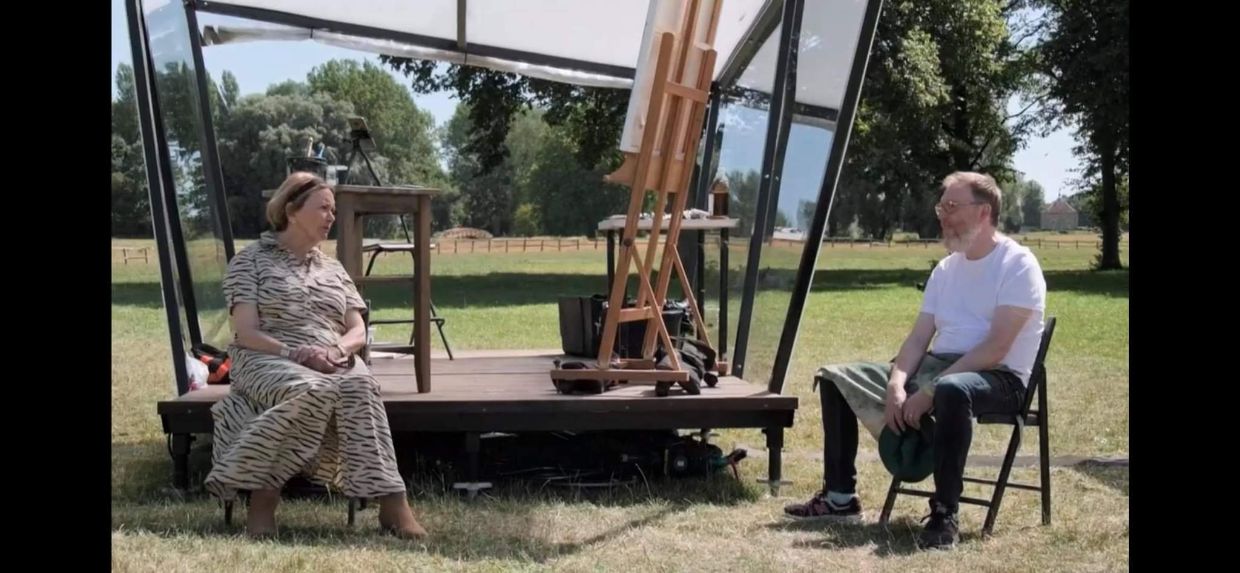
‘So what are you listening to?’ a voice from behind me asks. I disentangle myself from the headphones on my Walkman and wipe my paint covered hands with a rag. I turn to shyly greet Dame Joan Bakewell, the person asking the question, who is standing there with members of the TV crew who are all masked up. I explain that I have the shuffle setting on, but I had just been listening to Bob Dylan. ‘Have you listened to the new album?’ I have. ‘It’s really good isn’t it? I just love his words. I’ve just had Jonathan Miller’s son print me off all the lyrics so I can read them’, she says disarmingly, as if I of course know Jonathan Miller’s son, as we make our way to the front of my ‘pod’ for an interview. It’s about 11 o’clock in the morning and I’ve been painting for an hour. My interview with Joan, which lasts about half an hour will turn out to be one of my personal highlights from this rather heady and at times gruelling day, painting in the sunshine in my green bucket hat with large TV cameras just inches away. She’s really warm and engaged on and off camera (she’s been doing this for a long time after all…), and we chat quite a bit about painting of course, but also teaching and Birmingham and what my largely Muslim students would make of this place, with its enormous grounds, grand follies and houses. I don’t really know what I make of it other than it makes me very uneasy that it even exists and, with the college I work at located in one of the most deprived parts of England, I think they would feel the same.

It’s an issue that is picked up later in the afternoon by Stephen Mangan, the other presenter. We chat on camera and again I am asked, what with my submission of a landscape set in the urban streets of Birmingham, what I make of a place like this.  This time I explain how I see so much of the world through the lens of my working class upbringing and I’m very aware of the history of country estates and houses like this and how my Dad won’t visit them because ‘they are all built on the backs and blood and sweat of the working class’, he interrupts. ‘Well….yes,’ I say, not sure if he’s taking the piss.

'....one family?'
He asks me if I’m going to try and bring this into my piece, but in these circumstances I’m not sure how. Off camera, he tells me he is from a big working class Irish family and he totally gets what how I am feeling. He tells me that when he drove onto the estate in the morning his thoughts were ‘One family…?!’ 
Joan Bakewell and Stephen Mangan

I had risen early from my bed at around 5.30am. The Travelodge I’m staying in is on the High Wycombe ring road and the noise from the traffic, combined with my nerves had ensured I didn’t get much sleep. I have to be at West Wycombe Park for 7am, but it’s only 2 miles up the road so I’m really early. I have a cup of tea, shower, get dressed, and in the cool early morning air head over the ring road to where my car has been parked in the NCP car park all night. I’m a bit anxious that all my painting gear is still safe in the car (I am from Birmingham after all) but thankfully it is. I slowly drive the car down the winding ramps and head off.

 The Park is surrounded by a high wall with a huge gate that opens just as I arrive. Immediately inside there is a car park which a few other cars nervously follow me towards. These are some of the 50 ‘wild card’ artists who will also be taking part today. There is someone from the TV crew waiting for us and, and after I identify myself as a contestant, a medic takes my temperature and I’m invited to load all my gear onto a golf buggy and trundle off, masked up and holding on tightly to all my stuff. We cross the enormous estate to where I eventually find myself at the site of the six ‘pods’ where the 6 competing artists will work from today. We are situated by a large lake opposite which, on an island in the middle, is a large temple like building, The Music Room. The estate once belonged to the Dashford family, who still live here, but it is now owned by the National Trust after debts were accumulated. I’ve done my google research. 

The 'Wild Card' artists 

I say hello to the other artists, who all seem as nervous as me, and we exchange a bit of banter. I immediately get on with one painter, Dougie Adams, but also enjoy talking to Kirandeep, who is also from Birmingham who is here with her sister, and Sophia and Rosemary who are both here with their spouses, and we chat away about painting and the show. I never get chance to speak to Renata until the end of the day as she arrives later with the air of an artist on a mission so I’m a bit afraid to approach her if truth be told.  I’ve watched 2 series of this programme during lockdown so it all seems very familiar on one hand, but of course very strange to now find myself here being escorted to pod number 3 while the camera crews set up. I jump up on the stage, which is smaller than I thought it would be, excited, inside feeling a bit like a little kid trying to take it all in. I’m feeling ok after all my preparation, but it’s hard to think straight with all the activity around. I have thought all along that it would be unlikely that I would win today given the nature of the task, but I do think I’m a pretty good painter and so my own slightly more modest ambition is to at least be recognised in the top three artworks of the day. 
The Pods
I’m coming out of the portable loos at 9.30 when I hear a voice say to me, ‘So you must be the guy from West Bromwich who doesn’t like football!’. It’s the judge Tai Schierenberg, a very fine award winning painter, who had been an artist in residence at West Bromwich Albion a couple of years ago. I had watched a fascinating programme about it, as Tai, now a devoted Baggies fan, had never even been to a football match before his time at the club, but now he regularly travels up to The Hawthorns. We have a nice chat about it all, including my personal misgivings about football, as we walk in the sunshine towards my pod where I am now being invited to at last to set up and get ready to start at 10am. He wishes me good luck. The camera crew wants to film us getting our art equipment out, squeezing tubes of oily paint etc. before Stephen Mangan and Joan Bakewell announce (twice) the start of the programme and our four hours of work. The silence as we all set to work by the lakeside as the cameras finally roll feels deafening. It all feels very surreal. I was waiting for the incidental music to crank up…
The start...
...starting my painting

And on the whole I thought my day’s painting went well. I took my time getting the composition and drawing right on the canvas in the first hour. I thought my composition, although simple, was strong and well-balanced. I would occasionally leap off my pod’s stage to look at my painting from a distance and would steal a glance at the other 2 easel painters work, Dougie and Sophia, but not for long, there seemed no point really. It was important to just stay totally focussed on my own work and think about what I wanted to do with this rather sentimental, picturesque scene in front of me.  But there were many interruptions as you were invited to speak to one of the judges- I spoke with Tai and Kate Bryan- and the presenters, but also to speak ‘to the camera’ where one of the crew would ask you lots of questions about how you were feeling about taking part, how your painting was going etc. In these ‘to camera’ sections I kept having to repeat my spiel as I constantly referred to being in ‘the show’ and not ‘the competition’, which was how they preferred it to be referenced. ‘Can you not say ‘The Show?’ Can you say ‘The Competition?’ And again…’ the woman in charge of these segments kept patiently telling me. That was a bit more difficult but all good fun too, but admittedly it did get in the way of thinking about what I was doing. At the end of the day I don’t work like that. I work for long periods uninterrupted trying to reach a place with a painting where it takes on an integrity of its own that you then have to respond to. Finding this was difficult.

After two hours work a packed lunch was bought over and I ate mine under a shady tree chatting with Dougie. When I returned to my pod I felt the pressure mount in the afternoon as I tried to push on and try and shape my painting into something more exciting and original, which I found hard given the scene. 


We had started back at 1, and with the competition being to create the painting in 4 hours, I had my mind set on 3pm or thereabouts as when we would finish as no one had said otherwise. I put down my brushes at five to three, feeling a bit wiped out at this point. and looked around only to see everyone else still working away as if they had bags of time. I asked one of the TV crew what time we finished and she said, ‘Oh, we have another hour and a half yet!’. As a teacher by day, with my exam invigilator’s head on, I thought, ‘well we could have had more warning about that!’ They were of course, including all the stops taken by us all to do interviews etc into consideration but no conversation had actually occurred about how this would affect the time which would have been helpful. We probably all did about 6 hours painting in the end. Anyway, feeling rather foolish, I sat for a while looking at my work with fresh eyes before picking up my brushes again and before long found myself working with a deeper concentration than I had managed all day back into the painting for another hour. I tried to maintain a more holistic approach to the painting than fuss with details, although the Music Temple, which was central to the view, made this near impossible, until time was finally called.


My finished painting, oil on canvas, 100 x 78cms

We were all really exhausted as we stepped off the stage and walked towards the cameras for a shot of us ending the session. It turned out to be four more shots as we all did this really badly, much to the director’s dismay but my amusement (we are all artists not actors after all…) ‘Just look at my red T shirt as you come towards us!’ he barked before ‘no, back again….jeezuz’ he muttered under his breath.

The finished artworks by the 6 Pod artists
The six Pod artists 
The artists were escorted to another, cool in the shade, part of the park for a sandwich and a welcome drink but with little opportunity to look at each other’s work which I thought was a shame, while the judges assessed our efforts back near the pods.  
The Judges, curator Kate Bryan, artist Tai Shan Schierenberg, curator Kathreen Soriano

Of the easel painters I could see that Sophia had struggled to finish, but Dougie had completed a nice, subtle painting and I felt sure he would get in the top 3. I felt very nervous but also very unsure of where I would end up in the selection. I thought I had done a good painting that had a great deal of vitality and life to it despite being created in these difficult circumstances (although I can see now that I didn’t do very well with capturing the integrity of the Music Room/Temple). Would I make the top 3? I really hoped so as we were eventually called back to stand in line next to our work in front of an audience of many of the ‘Wild Card’ artists who had now made their way down. I felt like Maximillian in front of the firing squad in Manet’s painting ‘The Execution of Emperor Maximillian’(I’m actually not kidding about this).
  
Waiting to hear the shortlist (this was horrible...)

And then the names were called out by Stephen Mangan as the Judges stood behind him- I’ve noticed they never make eye contact with the artists at this point- ‘Rosemary Firth, Renata Fernandez…’ and at this point after the calling out of the names of the first two artists I had a terrible, sinking realization that I had not gotten into the top 3 as I knew Dougie would certainly be in it. ‘and Dougie Adams…’. I felt absolutely gutted, really surprised at how competitive I had felt in the end. The judges applauded and walked past us with their commiserations but I felt a bit numb. Kathleen Soriano said to me as she passed ‘Oh, I loved yours!’ and I thought to myself, ‘Yeah? Well why didn’t you bloody pick it then! (My apologies for my lack of magnanimity at this point. I’m just trying to write honestly about the experience). The three artists who hadn’t made it through were told to wait in the field adjacent to the easels until the winner was called. I felt really fed up, and to make it worse I was then asked to do one more interview to camera to tell the viewers how I felt about losing….great. 

Dougie won the heat, a worthy winner I thought. We then had to tidy up our pods and pack up our equipment as our paintings were taken away to be wrapped up somewhere else on site. There had been some art materials available- some nice oils, acrylics and charcoal which I was told I could have which was very generous. Looking around all the activity as the crew started to pack up to my surprise I noticed the judges walking away. After spending six exhausting hours painting, weeks preparing, and then not getting through to the top three, I was hoping they would come over and offer us bit of feedback or at least some advice for the future- I think we all deserved that, but no, they were off. That was it. I was left with my disappointment, and a sense of ‘well, what happened there then?’. I suddenly felt like a small cog in the big machine of the TV production. They had got what they needed. I’d made a painting for the TV show. I could go now.

 When I made it back to my car and headed back up the motorway I felt exhausted, but also surprisingly upset about it all. To not get any feedback at all had really knocked my confidence, as if I wasn’t really worthy after all. I put Courtney Marie Andrew’s ‘On My Page’ album on the stereo, which seemed to fit my mood perfectly, and went home. 

After...

'The Far Field IV', oil on canvas, 30 x 30cms
Five months later I finally hear some feedback on my painting, which I have not looked at since I came home from West Wycombe Park, when I sit down to watch episode 2 of series 6 of Sky Arts Landscape Artist Of The Year in January.  In the five months since the filming I have made 20 new paintings- my recent pylon works- trying several new approaches in my painting through the autumn to winter with a quiet determination to prove something to myself and try and put some creative distance between myself and the TV experience

I’ve been absolutely dreading watching the programme and have even had sleepless nights about it wondering what the judges actually thought and said, but also how I will come across. Yes, it would be fair to say I had lost a bit of perspective.

 It turns out that the judges, particularly Kate and Katherine, did like it after all, even referring to it as the ‘Disco Temple’ because of my use of colour, which I liked.  

Independent curator Kate Bryan

At the halfway point, when the Judges have a bit of a conflab Joan Bakewell had said ‘well Shaun seems to know what he’s doing’, a phrase I thought I might get printed on a T-Shirt with Joan Bakewell’s name under it.  The episode itself was not the best. I thought all the interesting bits of watching the artists at work which I have liked about the show when I have watched it did not feature, and neither did I in the end despite all the interviews and filming. I thought that might be the case though as I hadn’t made the top 3. I thought the ‘narrative’ of the episode would be cut around the 3 top artists of the day. Within an hour of the show being on however, I had sold a painting from my website store and by the weekend had sold two more, including my submission piece. For the next few days and more I received loads of positive feedback through my social media accounts about my appearance and more importantly my painting from friends but also fellow artists from all over the country, many of them past contestants on the show, praising my work and wanting to know more about my painting practice.  Although I’m aware that it can be creatively fatal to take much notice of criticism both good and bad and that it’s best to just get on with ‘the work’, all this positive feedback does really give my confidence a much needed boost. Other artist friends offered a more critical perspective ranging from wondering what I was doing on the programme anyway as It seemed nothing to do with what I do, that the judges were ‘so empty’ and ‘where do they get these people from?!’. One friend the way the ‘wild cards’ are treated is ‘demeaning’, and many thought my painting was the best by far, which was nice (let me put that that one in).  One friend said the difference with my work and the others was that it was actually ALIVE! Another artist friend who I met in Cornwall a week after taking part gently reminded me, ‘It’s just a TV show…’

'Empty Streets', oil on canvas, 50 x 40cms (the painting that got me 
in the competition. Now sold)

A TV show or not (I hear those words again…’can you say ‘competition, not show?’) the programme has seemingly created a ripple effect in the weeks that have followed with more and more people taking an interest in my work. The best and most tangible thing to come out of it however, is the contact I have made and the relationships I am beginning to form with other professional artists. In fact, later in the summer I’m returning to West Wycombe park with the artists I met at my episode and the others who featured there in episode 4 to stage a live (not online!) exhibition of our work from the competition and some of our other work at the National Trust house at the Park (I’m not sure what my Dad will say!). That’s a lovely and unexpected outcome.  In the meantime, I’m learning a great deal, not least that I’m not as good as so many of the artists I’m in touch with, and it is pushing me on to try and make my own work much stronger, be more critical and ask myself more questions about the work I do make and put out there. I’m making a lot of work at the moment, but a great deal of it I’m rejecting, painting over things to and try again and be more willing to try something different.  

Beckett’s famous quote: “Ever tried. Ever failed. No matter. Try again. Fail again. Fail better’’ seems to sum my experience up, as it does so much of anyone’s attempts to be creative and to try and do something worthwhile and fulfilling, which in the end my participation in the competition has proved to be. 

******

Can I move on now…? I’m sorry this has ended up reading more like a short story. It’s been difficult to write as I’ve been very conscious whenever people have asked me since what it was like my thoughts always come back to the difficult end to the experience. Yes, maybe I did lose perspective, but painting is so important to me, and I still think the judges should have taken the time to speak us with us all after how much work we had done. As an artist we are always made to feel grateful for any opportunity, and I felt that this was no exception and have had this said to me about this opportunity too, but as artists  our passion for what we do is also continually exploited. We have to exhibit for free, give up our time for free, often we have to pay to exhibit (!), appear in front of millions watching on Sky Arts for free and yet still be grateful. It will do our careers good etc. And we are, and sometimes it does and sometimes it doesn’t and on it goes…I’ve had so many experiences as an artist very similar to this over the years. I wanted this one to be a little different. I just wish that our skills, experience and passion for what we do was respected and treated a bit better sometimes. 

Friday, 19 February 2021

Groundhog Day

 (I’m having really difficulty completing a second part blog post to my experience of Landscape Artist Of the Year so I thought, in the preferred spirit of looking forward not back, I would prefer to write briefly about some of the work I have made since the start of the New Year….)

'Winter Walk', oil on canvas, 50 x 60cms, 2021

Having completed a large painting at the end of the 2020 in the series of pylons in fields I wanted to draw a line under this work at this point. I was feeling a bit exhausted with the theme for now, but had no particular plans for anything new.

When the New Year started and we soon sadly entered Lockdown 3 and I found myself working from home again, remote teaching, I ordered 10 small canvasses (50 x 60cms) with plans to experiment with  trying to create some new paintings based on some photographs I had been taking with a new DSLR camera I had for Christmas (a fab present!) on my familiar lockdown walks. I was interested in trying to capture something of the feel of the winter from photographs in which I have been trying to teach myself how to use the camera  and try to understand how to manipulate exposure using only the manual setting to explore mood and atmosphere through light and colour.

'Winter Walk', oil on canvas, 60 x 50cms, 2021
'Winter Walk', oil on canvas, 50 x60cms, 2021
I am really enjoying using the camera, but the paintings I created through January where I used some of these photographs as a starting point, particularly with the colour and light, were less successful and I found myself constantly re-
painting most of them to seek something that spoke more to me about these walks. The most pared down ones are the ones I’m eventually happiest with and will keep, but I’ve been struggling with painting the woods and fields, although I find them very beautiful to look at. I’ve found it hard to ‘key’ in to ways of painting the scenes that I’m happy with. As I worked on them I thought the motif of the path, which I continually find myself on day after day, was a good metaphor for the lockdown situation and it’s groundhog day feeling.
'Winter Walk', oil on canvas, 60 x 50cms, 2021
One afternoon, after some of the heavy snow we had fall in the area, I went out with the camera to try and take some photographs as the light faded from day to evening. I took some good photographs in the local edgeland woods, but as I came back onto my estate some of the parked up cars, covered in snow, and the snowy paths and roads caught my interest and I took a few photographs of these and printed some of these photos off. On a bit of a whim last week I created a small painting from one of them, rich in violets and blues from the snow in the twilight and ‘Bingo!’ I felt very excited and something creatively seem to open up, much more interesting than the landscapes I had been slogging over, and with much more potential. 
oil on canvas, 30 x 45cms, 2021
oil on canvas, 45 x 30cms, 2021
oil on canvas, 50 x 60cms, 2021
oil on canvas, 60 x 50cms, 2021
Over the next few days I created five more paintings of these scenes. They seem very evocative and moody, and also capture something of the lockdown with their sense of expectancy. Most importantly they feel much more me and more distinctive. I feel back on the road once more…
oil on canvas, 50 x 75cms, 2021

Thursday, 14 January 2021

Sky Arts Landscape Artist Of The Year 2021- Part 1 (Before...)

'Empty Streets', oil on canvas, 50 x 40cms, 2020
My selected entry to Landscape Artist Of The Year 2021

 Happy New Year. I can finally tell you about my participation last August as a contestant in Sky Arts Landscape Artist of the Year 2021, which started a new series this week on Wednesday the 13th January at 8pm. Up until now, as a condition of taking part, you are understandably not allowed to share anything about the programme on any social media platforms in case you spoil the result. I’ve been given the nod to share stuff about it now, but still can’t obviously share the result or my artwork from the day, but I thought it might be interesting to write about my ‘before and after’ experience. With this in mind this is the first of two posts- the ‘before’. A few friends know about my participation, but only a small handful know how I actually got on. 

For those that don’t know about the competition and have not seen it, it follows a similar format to it’s sister programme ‘Portrait Artist of the Year’ which has just finished it’s current run. Both series are presented by Dame Joan Bakewell and actor Stephen Mangan. Each weekly heat features six professional or amateur artists selected to compete from the thousands that apply by sending in a landscape painting (or drawing or print) and a short statement about their piece, the most interesting of which are then selected by the show’s judges and you are invited to take part. The show’s judges are highly respected and experienced curator’s Kathleen Soriano and Kate Bryan (look them up- what amazing CV’s!) and the rather brilliant painter Tai Shan Schierenberg. The artists then have to turn up at a given location (the specifics of which I was only told a few days before to avoid any cheating or practising beforehand) to set up in a ‘pod’- a small stage with easel, table, even materials if you need them, and a much needed roof-for each artist and in just four hours complete a ‘plein air’ artwork from a 180 degree view of the landscape in front of them. Working nearby are also 50 ‘Wild Card’ artists also invited along from the entrants but who didn’t quite make the competing six, one of whom from the six heats is invited to compete in the semi-final. At the end of the four hours the finished artworks are judged, a top three selected, and then from this an overall winner who progresses to the semi-final. So it was strange having spent much of the first few months of lockdown really enjoying watching both recent series away from the horrors outside in the Covid world, to be contacted by the show to be told the judges loved my own entry for this year’s competition and can I take part?!  Strange, but also incredibly exciting and gratifying. It felt like a real achievement to just get selected. For once, I felt quite proud, a feeling I never carry very easily.

'En Plein Air'
The painting that had been selected was, I think, a very unusual one, ‘Empty Streets’, and features at the top of this post. It is a painting of a bus stop near my Birmingham home based on a photograph taken on my phone on the way home the day I was sent home from work, as a college lecturer, last March and all schools and colleges were ordered to close as the pandemic took hold. It was an anxious and worrying moment in time, and the empty illuminated digital hoarding screen on the bus stop attracted me as it appeared like some sort of portal, gateway or door to a parallel reality to the familiar world I knew. If only I knew now ten months later. I painted the painting that night and always felt there was something about it that was hard to pin down but I thought was good. I eventually sent it to the competition thinking this a couple of months later, but also wrote about its relation to the pandemic in my statement. I wonder if this also caught the judges eye, because after all I think a landscape painting should have the power to conjure up or reflect the circumstances in which it was made. 
Working on location....

After the initial excitement I thought I’d better do some serious training for the competition, because as much as see myself as a landscape painter I don’t create my paintings ‘plein air’- although I do occasionally make such studies, but that’s all they are- my paintings are very much studio creations developed from many different approaches and, from my experience of watching the show I would be competing against some serious professional and experienced ‘plein air’ painters. And to make a painting in four hours? Well, many of my paintings are actually created in less time than that as they are very pared down and I often find myself overdoing it when I work too long on a painting. How to retain the qualities that mark my own work out and not make a poor attempt at trying to compete with the plein air artists and do something that retains some vitality in four hours, these were the questions that, with the Rocky soundtrack in my ears, I considered as I set to work. I had six weeks before I went in mid-August. I must say it was an exciting distraction from the pandemic and the months I had spent in lockdown. 

Many of the locations, though not all, are often on country estates in parts of rural England and when I was told I would be painting at an as yet unspecified location in High Wycombe I of course googled the area. I thought the most likely place would be a large National Trust estate called West Wycombe Park or possibly an airfield nearby. I was hoping for the airfield! But either way I knew that, unlike my paintings set in the urban West Midland edgelands at night, I would be painting scenery that would be very unlike anything I was used to painting and in the daytime too. With this in mind I spent time in the studio making small studies based on photographs I had been taking on my lockdown walks in local green spaces such as woods and fields trying to build up a painting vocabulary for painting such things that felt my own. The studies were also influenced initially by favourite artists I often lean on such as Lois Dodd, Alex Katz, Fairfield Porter, Diebenkorn and De Kooning, as well as Daubigny and Morandi. I also watched lots of youtube videos by ‘landscape’ artists to gain some useful technical tips, especially about mixing suitable colours for painting terrain, but soon got bored of this. Much of it seemed as far away from my idea of painting as it could possibly be and quite depressing. 
...at RAF Cosford Museum, Telford

The most useful work I did was actually going out and working on location but this also took some refining as it was quite hard to find suitable locations that ticked the boxes of where I may find myself painting in the competition. Plus the practical considerations of working more seriously ‘en plein air’, such as organising and carrying your equipment, setting up, what size to work on and discovering how long I needed to work. Could I do it in four hours? I had a few false starts working on small panels at Edgbaston Reservoir, which I didn’t like, before taking a bigger canvas and working in a small cemetery overlooking a very old church on top of a hill with tremendous views over the Worcestershire countryside. I would have been happy to just paint the view but I felt tackling the church would be important. This went ok, but after 2 hours tops I was done. 

Next I went to RAF Cosford of all places, the magnificent airforce museum near Telford, and set up in the grounds there to paint a large plane and hangar. Rather typically it turns out a society of artists that specialised in painting aeroplanes was having a conference there that day! In my experience these sorts of artists are not only technically proficient in a way that I could not hope to be, but also incredibly particular about detail, but when one of them eventually wandered over to me, which I was dreading, he was very complimentary about my rough looking painting. Another passer-by started talking about that ‘artist on the telly, very good he is, can’t remember his name…’ ‘Bob Ross’ I said tersely as I knew it would be Bob Ross. ‘That’s him. Does great clouds…’ My clouds weren’t looking very good. I went home- this time after 2 ½ hours-having a crisis about clouds realising that I hadn’t actually in 30 years of painting really painting them. I looked at the work of some of my favourite contemporary landscape paintings and oddly realised that they never did too. You’ll never see a cloud in a George Shaw landscape. I spent the next few days practising nothing but clouds very badly. I eventually ended up with ‘Skatepark’. 
'Skatepark', oil on canvas, 50 x 75cms, 2020
In between all this there were lots of contracts and disclaimers to sign, a telephone interview ‘all about me’ with the show’s producer- which was very enjoyable, and a timetable for the day sent through (though still no confirmation of the venue), as well as someone arriving from the ‘art team’ picking my submission painting up to take to the production. The show’s production team were incredibly helpful and friendly, and in all my experiences of working in the artist-run and publicly funded realm of exhibitions, which has been such a slog over the years having to chase after everything, it was great to be treated so nicely but also so professionally as an artist, as if you really mattered and were actually the artist by the way. 

Finally, a few days before I went to the competition I went up to my friend Liz’s farm and worked in a field there next to a lake by a house with a great reflection in the water. This painting was by far the best and biggest one- 75 x 50cms- I had made so far under these conditions and it took me just over 3 hours. I was beginning to feel more prepared, and after much consideration I decided to take a bit of a gamble and take the biggest canvas I was allowed at 120 x 100cms, knowing that I am more comfortable working big, and also this would suit the timescale. I did buy two of them though. By this point I had also invested in quite a large toolbox on wheels to carry my large tubes of paint, the countless brushes I use, and my bottles of medium, palette, easel etc. ‘Plein Air’ painting is meant to be more portable with the artist travelling light with his pachode box, but not me. I prefer to follow David Hockney’s example, but without all the personal assistants! 
...working at Liz's Farm (thanks Liz!)

I felt that all this preparation had been important, but I did feel, and you might share this view too on reading this, that I had got to a point where I was overthinking it all. It was a big deal for me though. Painting is the only thing I feel I'm pretty good at in my life. It’s a chance to get some important exposure as an artist and take part in a big competition where the winner is awarded a prestigious £10,000 commission. It also seemed conversely a risky thing to be doing in case you made the worst painting you have ever made in front of an enormous TV audience. A couple of days before I was due to take part it was confirmed that we would indeed be working at West Wycombe Park and would be required on set at 7am until 7pm. The afternoon before I headed off with all my gear in the car to a travelodge in High Wycombe where I would be spending the night with just me and my nervous thoughts. It felt like I was heading off to battle...

Tuesday, 29 December 2020

End of Days

 It’s been such an intense, surreal and difficult year. Even so I think I’m in a better situation than many with regards to the pandemic and its effects on my life. I have a good, steady job as a Fine Art lecturer which has continued since March, a roof over my head, food on the table, space for my kids to play outside. At one point in time these were seen as almost the given basics if you could hold down a job, but since the Eighties and Thatcherism, accelerated at unbelievable speed since 2010, so many have seen a complete degradation in their job conditions, can barely manage to find and keep an affordable home, and even put food on the table. These things have preyed a lot on my mind lately and especially over the Christmas period.


It’s the incredible work of scientists, hopefully with the vaccine, that will help the world return to some sort of, albeit deeply scarred, normality in 2021, but I think it’s important to acknowledge how our cultural lives can offer so much support as a way of navigating ourselves through difficult periods in our lives. Art, music, books, film, theatre and TV can be incredibly inspiring, affirming and consoling as we see aspects of our lives reflected back at us- it’s what I seek in much of the culture I seek out- but also can be a great escape from it all. I’ve been thinking about what I have discovered this year that has helped me through these times….

'Death of Winston Rose', Denzil Forrester, oil on canvas, 1981

With galleries closed for so much of this year I’ve not been to see much art, but before lockdown in March I loved visiting the exhibition of paintings by Denzil Forrestor. ‘Itchin’ and Scratchin’, at Nottingham Contemporary. That was a definite highlight of the year- the paintings were so full of life, be it in the character’s lived depicted in the scenes of the Afro-Caribbean community of dub clubs and tough streets, or in the artist’s very sophisticated use of colour and form and his use of drawing in his vast, complex compositions. They had something to say that felt borne out of a lived experience and possessed a sincerity, directness and honesty that reached out to a wider audience. They were a refreshing change to so much art on display and spoke deeply to me, taking me back to some of my own formative roots in painting. I looked closely at Denzil’s paintings as a student in the early 1990’s, and even had tutorials with him, and learned a lot of lessons from his work which I still apply. There is a great lively interview with Denzil on the ‘TalkArt’ podcast that you can find on many podcast apps. I use Castbox to download or stream the regular ones I listen to.  

Poet Roger Robinson (photo courtesy of The Guardian)
Sort of related, in the sense that his work is rooted in his experience of being a member of the black community in Britain and also in the Caribbean, Roger Robinson’s award winning book of poetry, ‘A Portable Paradise’, is the book that had the biggest emotional impact on me this year. Many of the poems deal with the Grenfell fire tragedy and are incredibly moving, and unsurprisingly upsetting, causing a tightening across the chest in this reader. Others deal with the experience of being an immigrant, a refugee, or a black artist in words that have a calm anger, wisdom and clarity of vision. In the year of Black Lives Matter and where we are all hopefully (I know this is probably naïve but I certainly am) thinking with a greater awareness of the experience of black people in this country and the US in particular the book is very prescient. I can’t recommend it highly enough.
Comus as featured on compilation by Bob Stanley and Pete Wiggs 'Gather In The Mushrooms'

If I were to choose any music that has been a good companion this year it will be the discovery of some of the thematic compilation albums of music created by Bob Stanley and Pete Wiggs. This began with ‘Gather In The Mushrooms’, an album recommended in the ‘A Year In The Country’ book I have discussed in previous recent posts (this, alongside Mark Fisher’s ‘The Weird and the Eerie’, would be my other book of the year for how many cultural doors it has opened to me), a collection of Psych and Acid Folk Music from the late sixties and early seventies, whose songs from a wide variety of artists is rooted in a slightly otherworldly English folk tradition. I love it and found myself really immersed in its musical landscape during the long summer evenings in the studio. A particular standout track is ‘The Herald’ by Comus, which is such a stunningly atmospheric song. I have a vivid memory of painting late one evening in July a scene of local woods and sitting exhausted at about midnight having finished the painting as this haunting track played on my Walkman and filled the room. I was pleased with the painting but the whole experience felt quite emotional: the effort of painting, my tiredness, the somewhat heady transportation of the album’s music to this amazing end track and coping with the whole pandemic and the effect it has had on my family in various ways.


This album remains my favourite of the compilations but I have also loved ‘English Weather’, a collection of early Seventies rock, in its broadest sense, by long forgotten and overlooked bands, ‘The Tears Of Technology’, also dubbed ‘the sadness of synthesizers’, a superb collection of late seventies and early Eighties English synth and electronic bands and solo artists including the brilliant lost classic ‘Private Plane’ by Thomas Lear (And if the opening short melancholy instrumental opening track by China Crisis doesn’t floor you well I just can’t help you, I really can’t). The most recent one I bought was the brilliant ‘Tim Peaks’, a collection of lost indie Eighties classics interweaved with more recent music by various artists with a binding link to the aesthetic of early Factory records (well apparently according to Bob Stanley and Tim Burgess who put this one together). Conceptually it is also a reimagining of Twin Peaks and it’s diner being relocated to a café in North West England and is thus an imaginary soundtrack to a late wintry afternoon near the Pennines with a mug of tea and a great jukebox in the corner looking through rain lashed windows. I like afternoons like these and have had my fair share of them when I lived up north in the West Riding.


In all of these records the sleeve notes are lovingly and enthusiastically presented by Stanley and Wiggs. It’s like listening to a great compilation tape put together with the joy and care of an older brother or good friend. It brings back fond memories for me of these experiences in my twenties when a new compilation tape would land on the doorstep from one of brothers at Uni, or the hours I spent putting one together for them or my wife. It seems from a time when these things seem to matter more.

The Adam Buxton Podcast (with dog Rosie)
Other listening pleasures include the Adam Buxton podcast of which I have listened to all 147 episodes now. It’s a great companion on the bus journey to and from work. Adam Buxton is a brilliant interviewer and in his ‘Ramble Chats’ manages to pull off the trick of seeming like he isn’t really trying in fascinating, funny, sometimes irreverent, in-depth talks with comedians, poets, writers, political and social thinkers, legends where Buxton is always warm and engaged. Two recent ones with the poet/activist Benjamin Zephaniah and Paul McCartney were compelling and brilliant. I could highlight so many more, but you should check it out yourself. I don’t know anything about so many of the people interviewed beforehand but always get something out of each podcast.
'The Mandolorian' on Disney+

And my escapism? That would have to be ‘The Mandolorian’, the Star Wars spin off series on Disney+. How cool is that show? I love it and is everything the Star Wars prequels and recent sequels have promised but never really delivered on, from the great storylines but also the design of it all, which is always the part of Star Wars that has made the deepest impression on my imagination from when I saw it as a kid.


It looks like 2021 is going to continue to be a rough ride for several months still, so hang on in there. Thanks to all those who continue to support me and show an interest in my work. Wishing you all well into 2021...


https://www.frieze.com/article/denzil-forrester-i-had-find-something-shook-me


https://www.theguardian.com/books/2020/jun/13/roger-robinson-poets-can-translate-trauma


https://www.theguardian.com/music/2017/jan/26/bob-stanley-and-pete-wiggs-present-english-weather-review-ace


https://www.theguardian.com/tv-and-radio/2020/aug/29/adam-buxton-dad-more-proud-of-me-but-he-was


https://www.theguardian.com/tv-and-radio/2020/mar/24/the-mandalorian-review-baby-yoda-has-finally-come-to-the-uk-was-it-worth-the-wait-disney