Friday, 23 March 2012

'Exile'

'Exile', charcoal on paper, imperial size, 2012

Friday, 16 March 2012

Dan the Man...


I was at Goldalming College in Surrey on Wednesday for a ‘Practical Painting Workshop for A Level Art- a practical guide from Cezanne to the Abstract Expressionists via Cubism’. It was a staff development opportunity that I was keen to participate in and hopefully get some new ideas for teaching painting, which despite it being my specialist field I do find a very difficult subject to teach. It was led by Daniel Fooks, the Head of Art at the College, who is an inspiration. I had previously been to a training session in 2009 led by him in London, ‘How to Get All Your Students a Grade A at A Level’, which he does every year, almost without exception. It is refreshing to hear someone who gets such amazing results say ‘I have no paperwork, just what the students make, no schemes of work, I can’t stand them’. His training day has had quite a profound impact on my approach in the classroom since, although sadly I do still have to do schemes of work despite telling my manager we don’t need them according to Dan.


It was a great day, and I did come away with lots of new ideas, but I thought I would post this to share the inspiration I came away with from Dan’s own paintings. They were in a makeshift studio space he had made in the class, and worked in alongside his students. These included this incredible set of five portraits of actor Peter Capaldi (above) that were selected for the BP Portrait Award last year. It also included a group of very large paintings based on his fascination with the forms and expressive qualities to be found in knotty trees. Although, very much derived from Cezanne’s techniques I found them really exciting. I spent my lunchtime totally absorbed by them in his studio space and having a chat with him about them. They gave me a great deal food for thought as I begin to develop my own forays into the landscape. It was a real privilege...


Tuesday, 13 March 2012

Is There A Place...?


I visited an interesting exhibition at The New Art Gallery Walsall on Saturday that featured lots of ‘Edgelands’ inspired work by different artists, including George Shaw, Paul Winstanley, Barry Thompson, and Birmingham based painter Graham Chorlton.

According to the gallery, ‘‘There Is A Place...’ ...brings together a group of artists who explore our psychic connectivity to landscape. The drawings, paintings and prints within the exhibition reveal 'a sense of place' as seemingly generic urban and suburban views evoke personal and collective memories. The reverie of teenage hideouts, suburban housing estates and motorway junctions, each depicted in painstaking detail, are at once familiar yet unnerving for all’. Mmmm...I think you can probably see why I might find myself interested in this with my own current ‘Edgelands’ interests...

A new artist to me whose work I found really exciting was Laura Oldfield Ford (above). She makes large-scale detailed drawings of the ‘Edgelands’ landscape in biro on top of layers of acrylic splashes and fragments of type which include graffiti, but also dates that reference some of the history of the locations she depicts. She had created some really striking drawings commissioned by the gallery of the underneath of the M6 motorway near Walsall, a stone’s throw to where I have been working in West Brom under the M5. One piece referenced a number plate that had been found in the undergrowth believed to belong to a car belonging to the IRA who had attempted to blow up this stretch of the M6 during the 1997 election campaign. Laura’s blog is a really interesting read: http://lauraoldfieldford.blogspot.com.


Laura seems to be as much of a writer as an artist, and I really enjoyed reading about the bus journeys around The Black Country she made to develop these commissioned pieces. She travelled around areas I know particularly well, the places I grew up, and I found it very grim reading at times. Some of it made me wince, as much as for the truths I recognised in her words, and her descriptions and prose reminded me of Black Country born writer Anthony Cartwright, whose novels, ‘Heartlands’ and ‘The Afterglow’, I have mentioned before.

Laura’s work had a much more politically and socially charged edge than the other artist’s in the show, whose work seemed much more informed by the personal and memory. This of course can be seen in George Shaw’s work but also in the minute and intricate pencil drawings of Barry Thompson. Like Shaw, Thompson’s work references his adolescence and idle hours spent in the town he grew up in. I r particularly liked these pencil drawings of poems written on small scraps of paper. I’ve been thinking of doing something similiar with bits of hand-written things I’ve been collecting for some time now. I felt a bit beaten to it....


In fact, I felt a bit beaten to it by lots of the work in many ways. As I’ve been researching my ‘Edgelands’ theme, I’m aware that it is a very well-trodden path by artists and writers alike. My task is to try and find my own distinctive voice within it all...

Tuesday, 6 March 2012

Thunder Road...

Pastel on Paper, A3 size

‘It’s a town full of losers, and I’m pulling out of here to win’…so sings The Boss on his classic song, 'Thunder Road'. This recent pastel really reminded me of Springsteen and his world of highways, cars, girls, escapism, and those battles to hold onto your dreams against the stark realities of life. He brings his vision so vividly to life across albums like ‘Born To Run’, ‘Darkness On The Edge Of Town’, and ‘The River’ etc. (For me however, that world is evoked so potently and brilliantly on the collection of never previously released songs that makes up the ’18 Tracks’ album). I’d like to think my drawing had something of the bleak beauty and dark heart of ‘Nebraska’, but let’s not get carried away…

Bruce’s new album, ‘Wrecking Ball’ is out this week, and proves that that at 62 he’s more than just a contender, he’s still, without doubt, The Boss, on what is an angry and political record. Many of the songs possess an Irish rebel song flavour that reminded me of ‘The Wire’ and those drunken barroom scenes where all the cops used to hang out…The writers of The Wire were all big fans of Bruce, which may come as no surprise…

Friday, 2 March 2012

A Tree With Roots...

I spent yesterday at Padstone Day Services in Bromsgrove making an oil study of a tree at the back of the centre. Padstone is a Day Centre for people with learning disabilities where my wife, Diane works as a Senior Day Centre Officer.

The centre is due to close in a few weeks due to cuts being made by Worcestershire County Council, and relocated at a much smaller building nearby. The new building is currently being refurbished and has lots of large wall spaces they are keen to fill with some paintings, so I’ve been asked whether I would consider making something. The tree motif was suggested by the staff, as it is a tree that is fondly thought of by service users and staff and is always viewed from many of the rooms in the centre, and could represent memories of Padstone, which will soon be demolished, at the new location. So yesterday I went along for the afternoon to view the tree myself and make some studies to get a feel of it myself as a possible subject.

It was a great tree and a beautiful day to paint outdoors, but I wish I had allowed more time. I painted these two panels in a few hours and was just going to add more on the side for the outward expanding branches when I had to pack up. I was just getting to the point when one starts to lose themselves more in the activity and really start painting after drawing and building things up.

It may seem obvious but David Hockney’s trees (above) were obviously at the forefront of my mind after last week’s exhibition. They did help me, as I’ve not done many things like this, and made me a bit bolder with the colour, particularly in the building behind, which I enjoyed (it also was beginning to develop into a Hockney type ‘joiner’). I’ve also been thinking a lot about ‘portraits’ of trees as a subject in the edgelands, so this was not unrelated, which is why I thought it would be worth exploring. And it was. I enjoyed it. I’m just not sure if this ‘portrait’ of the tree would be the best idea to make a suitable painting for the new centre. It was a good ‘edgelands’ subject though…

Monday, 27 February 2012

The Great Receiver...

BRILLIANT! These seem like the only words I can use to describe seeing ‘David Hockney: A Bigger Picture’ at the Royal Academy, London on Thursday. I left the exhibition grinning from ear to ear, feeling totally uplifted and as if I had just enjoyed an immensely satisfying meal. I haven’t enjoyed an exhibition so much in years. The exuberant colour, the light, the sheer continual, restless inventiveness was just so wonderful to participate in. It made me feel so alive. How many contemporary art exhibitions can you say that about these days?
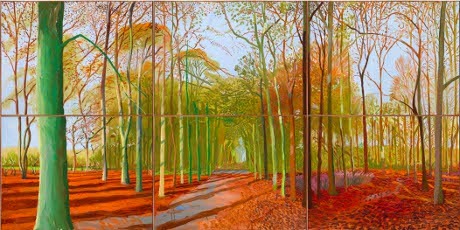
At 74, Hockney’s playfulness, skill, and visual intelligence and creativity just seemed to knock so many younger artists into a cocked hat. Aren’t the young meant to be the ones with all the fresh ideas? (Not if Birmingham’s Eastside Projects current ‘Painting Show’ is anything to go by either. In stark contrast, I left this exhibition feeling thoroughly frustrated and empty recently). ‘A Bigger Picture’ was brilliantly hung, taking the audience through the development of Hockney’s involvement with the East Yorkshire Wolds and the many developments he has made in the last 5 years in his attempts to capture the ever changing landscape through the seasons. My particular highlight was the room of paintings of the Wold Woods (above), where things just seemed to come together incredibly well: the handling, the language of marks, the colour and light, and the scale.


I also found myself really liking the more recent work created more from memory, which I thought I wouldn’t enjoy so much as it seemed so mannered or stylized, but they made perfect sense in the flesh, particular with the enormous final painting, ‘The Arrival of Spring’ (above). I loved these, and felt so ‘there’ in these landscapes. They seemed so rooted in a Modernist tradition to me, and reminded me a lot or Rousseau as well as the more obvious touchstone of Matisse. I think Rousseau’s landscapes are terrific, and have always admired his treatment of forms and the clarity of his vision. These are some of the qualities I think were reflected in Hockney’s most recent paintings. The works created on his i-Pad were also amazing, (below) and really got me thinking about whether this would be a good tool for me with my efforts at working on location if I could get to grips with the technology…

This all seemed a perfect start to 'A Portrait of The Edgelands'. I sit and write this tremendously excited by the possibilties, my head full of ideas, thinking, 'Yes, I can!'.

And what does The Great Receiver mean? Come back in a few days....

Wednesday, 22 February 2012

A Painted Life....


I’ve been thinking a great deal in the last few days about ‘Lucien Freud: Painted Life’, the riveting film that was aired on the BBC on Saturday, about the life of the late painter who died in July last year. I was immediately gripped and very moved by the opening scene of him painting in his studio, filmed by his assistant David Dawson from his perspective as the model posing for what would prove to be his last, unfinished painting. In fact what moved me even more was the fact revealed that this would prove to be the last day he actually painted, as he died a few days later aged 88. I just found it unbearably sad when you consider the utter and total commitment he had towards his painting throughout his entire life, and here he still was still alert and so focussed still in his studio on this day, but looking frail. One sensed a feeling projected by him that time was running out, that there was a sense of fighting against the dying light. And yet maybe I’m projecting this idea a bit, because what came across in the film and in the work he created was that this was how he approached everything in his life: with a ceaseless energy and scrutiny totally committed to the moment of what he was working on at that time, usually portraits, often for months and months, pushing and pushing to something beyond mere appearances (In contrast if I could get my own portraits stripped further back to something even more minimal and essential I would).


It’s this side of things that I have never really enjoyed about Freud’s paintings: all the psychology that can seem heavily laden on in those early works and the later stagier paintings of Leigh Bowery etc. They can also appear very cold and clinical in their examination of the naked human sitter as ‘animal’. I prefer in his, and other painted portraits, the ones that do just deal with appearances, believing that the rest will follow if the other elements work. I think appearances are mysterious enough. The Freud paintings I really like are the portraits that are more intimate and restrained. I like most of all though his portraits of his dogs and horses, feeling these seem to project a warmth and love oddly not found in his paintings of people. The documentary talked about his love of animals throughout his life, especially when he was young, and I think this is reflected in these, compared with a deliberate distance and detachment from the people in his life. It was probably this that made him able to work as he did, and lead the life he wanted, free to just paint every day 24/7.


Someone remarked this weekend that my own paintings have a dispassionate quality too. I’m aware of this, and do try to be as objective as possible when I’m recording something as I like the idea of the subject revealing itself to me, rather than trying to force things into being. To be honest though, when trying to paint within the limited time I have, if I wasn’t so organised and practical I would never get anything done, and I think this can add to my work looking impersonal at times. But I’m also aware that this is part of my character; always on the outside looking in. I know many painters are like this. I’m convinced that for many, including Lucien Freud, it is why they do what they end up doing what they do.