Monday, 31 January 2011

A Big Night In...


The other night I phoned my friend after a tiring day’s teaching and asked if he fancied a pint. Sadly he couldn’t make it, so instead I went down to the studio. I’d spent the last three nights stretching and priming a canvas in readiness to attempt a painting that evening, but when it came to it, the beer and a chat with my friend seemed the more preferable option. I could have done something sensible like watch the telly or read a book but my mind doesn’t seem to think like that after all this time. The studio was the only other real option I had.

I had a great time there though…one might call it a really good big night in…

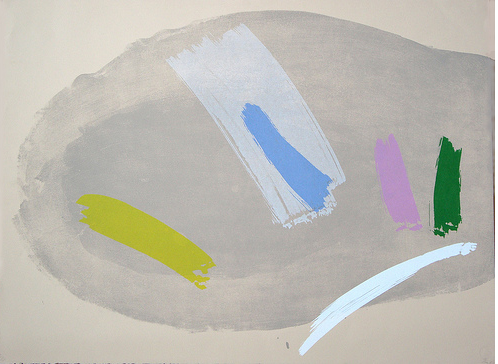
I’ve just finished reading ‘John McLean’, a monograph on the great Scottish abstract painter by Ian Collins. I really enjoyed it, and there are a few passages describing McLean’s paintings that particularly resonated with me that I’d like to share. The first is from a review by critic and essayist Tim Hilton:

‘A single mark in a McLean painting will evidently have been made by a single gesture, the tender primal touch of painting on canvas. Consider how complete and meaningful such a single mark can be: in its perfectly judged size; in its direction; in its viscosity, or dryness, or comparative dryness; in the way it can, elegantly or boldly, turn upon itself like a flourish or stand squarely. There is something newly born about this, just as there is great sophistication in it. But it is sometimes the case in art that it takes such a sophistication to make us see simply. And McLean is simply a master of touch.’


The Glasgow Museums Director, Julian Spalding for the city’s Museum Of Modern Art, writes this second. He wrote:

‘Some artists begin by looking at the world, then concentrate on what interests them by leaving things out. Others begin with nothing – an empty canvas – and build up a picture from there. This is like the difference between a Shakespearean tragedy and a Japanese Noh drama. Shakespeare begins with the noise of the world and leads you to a moment of silence and death. Japanese Noh drama begins with silence and stillness and slowly builds up to a dance. John McLean adopts the Eastern approach. His art relies on making the right mark on nothing. This requires concentration, thought, feeling and daring, so that everything he wants to say can be contained in the one action. When you tune your mind to McLean’s art the colour and the shapes in his paintings dance. The title ‘Strathspey’ painting may not conjure up for you an image of people dancing, but McLean’s picture is actually closer than a representational painting would have been to conveying the sensation of the dance itself.’

Something to hold and ruminate upon as I put brush and paint to canvas…


Monday, 24 January 2011

Close Encounters Of The Painting Kind...

The time issue I discussed in my last blog entry manifests itself in all sorts of funny ways I found myself thinking today. I’m reminded that someone in my position thinks more about the art they are trying to make more than actually making it, when this afternoon I found myself obsessively absorbed in playing with my two year old son’s colourful building blocks. I was trying out different colour combinations in different sizes and sequences in relation to a painting I’m hoping to tackle later this week. I was meant to be playing with him. No wonder he got bored and wandered away from my slightly manic and pathetic behaviour.

Richard Dreyfuss’s character in ‘Close Encounters Of The Third Kind’ came to mind later as I sat at the dinner table staring at my tea of Shepherd’s Pie. The way he obsessively started to play firstly with his own mashed potato, and then with increasingly bigger lumps of clay and earth as he tried to make real the ‘Devil’s Mountain’ visions that filled his mind. I love that whole idea in what is one of my favourite films. Not sure I want to be that character though….


Saturday, 15 January 2011

Time After Time...


'Escalator', John McLean, acrylic on canvas

I’m currently enjoying reading monographs on two favourite painters, John Mclean and Jock Macfadyen. I admire both artists a great deal and have read with great interest the individual struggles and hard won battles they have fought in their art to achieve what are quite singular visions in their own way, despite the many influences to be found in their work.
Their achievements have come through immense commitment but also so much time devoted to their work. It is time that has given them opportunities to develop ideas, experiment, end up in artistic corners, and take risks. Take it all apart and put it back together again.

'Tate Moss', Jock McFadyen, oil on canvas

I’m ruefully reflecting on this at the moment as I’ve had a slow start to the New Year in terms of getting in the studio. I want more TIME! Time to develop ideas, experiment, end up in artistic corners, and take risks. I’ve got bucket loads of commitment, that’s never a problem, but time as ever feels like a luxury. The luxury for the lecturer and parent who struggles to hold onto some sort of artistic practise.
I do seem to hold on though. I always do, its just some times are a bit easier than others. It’s a problem that most so-called ‘artists’ of any description constantly struggle with, be it the painter or the writer, unless they are hugely successful, which most aren’t (if you are to judge success in terms of making money. I try not to). The time in the studio though tends to make up for the difficult periods. The periods when the grinding gnaw and agitation of not getting in there really eats you up. Like I’m feeling now. Luckily I’m getting in there tomorrow…

John McLean

Jock McFadyen, 'From The Greenway', oil on canvas

It’s funny I find myself reading books on two painters that on the surface may appear at polar opposites. One, the lyrical abstractionist, the other a gritty realist. It’s all just painting to me, which is how I’m sure they view it too, but I find myself reading about them at a time when I’m wrestling with the direction of my own painting. I find myself enjoying creating paintings that explore the more lyric and abstract qualities in my own painting at the moment, but I am mentally wrestling with the idea of developing something that addresses my interest in something tougher and more urban. Of course, there is no reason why I can’t do both. No reason that is except for time….

Tuesday, 11 January 2011

Homeward Bound...

Martin Parr

I was in West Bromwich today for a meeting with Multistory director, Emma Chetcuti. Multistory are a West Bromwich based community arts organization that works right across the six towns of Sandwell, commissioning and developing a range of innovative and challenging artwork. My ‘Seek My Face’ portrait project was supported and managed by them in 2007-08.

Anyway, I had a bit of time to kill beforehand, so I followed my usual routine; coffee and cake at ‘Perfect Moments’ in the middle of Kings Square, which is a great place to watch the world go by, and also a bit of space to write in my journal, followed by a mooch around the town. I visited the new community art spaces in the empty shops I exhibited in last summer. They were preparing an exhibition by a local arts and crafts group. It was good to see that the spaces were being accessed by organizations like this and perhaps my exhibition had played a small part in encouraging local artists to use them. I then visited The Public to view ‘Black Country Stories’ by Martin Parr again.


I’d previously blogged about my disappointment with Parr’s exhibition but today I found myself looking at the vast range of photographs with fresh and much more excited eyes. I’d previously seen them at the very busy Private View, which is never the place to look at artwork, and today in the quiet I had a chance to view them with more contemplation. Having also spent the last hour or so in the town also helped think more about their context, although I am very familiar with West Brom, as it is my hometown, I don’t spend much time there these days, so reconnecting a bit with the place made me look at Parr’s achievements differently. I also think there is a lot to be said about your expectations for an exhibition, and when it doesn’t meet those what a disappointment that can be. Those feelings can get in the way of looking at the work at face value.

Today, I’d got over that obstacle and felt much more engaged with the work and its richness and diversity, both in terms of subject, but also mood and feelings. I saw things I hadn’t noticed before, and was very moved by some of the images, particularly the ones of young people in schools and clubs. At the moment with all the nasty attacks on the young by the government with EMA cuts and hiking up tuition fees, one just had to wonder in such a socially deprived place like Sandwell, what would become of these kids. Things have really gone backwards so quickly in the last few months. It is very sad and frightening.

I then went on to Multistory to discuss plans that they are supporting me with to ‘return’ the ‘Seek My Face’ portraits to West Bromwich. With Multistory’s help I’m donating the paintings to a range of different individuals and organizations in the town, which may include Tom Watson MP, the Town Hall, Sandwell College and various community centres.

Martin Parr

Trying to even give these paintings away has been a bit of a game to say the least, but with the help of a councilor friend I’m finally close to realizing an ambition I’ve written about in my first blog entry in 2008 of finding a home for the paintings in West Bromwich. They are all portraits of people from the town, and I firmly believe that is where they belong. I’ve tried other ways to realize this, including trying to create a limited edition of etchings based on my archive of portrait drawings, with little success. When I agreed to show my paintings in the shops in summer it was with the agreement that there would be attempts to try and find a permanent home for them, but again this came to nothing despite attempts. So eventually I used my own connections in the town to try and get something happening and this time this has proved rewarding. The old adage applies ‘It’s not what you know…’, especially in the arts. I felt a bit like I was playing the game like Senator Clay Davis in The Wire but sometimes this is what you have to do.

'Robert',
oil on canvas, 120 x 90cms, 2007

I’m really excited about it, and over the next few months I’ll report through the blog as the paintings are installed in their new homes. We are aiming to have everything complete by the end of March. It will be weird saying goodbye to these paintings, like waving goodbye to your children, but I’m ready for them to permanently fly the roost of my studio at last. I will miss ‘Robert’ above though. This is my favourite portrait of all the ones I have done over the years. The values presented in it are almost like a manifesto for my ideas in portraiture.

Wednesday, 5 January 2011

A New Year Letter to Vince Cable...

Bob and Roberta Smith

Happy New Year. And to see the year in here is a brilliant letter from Conceptual Artist Bob and Roberta Smith to Vince Cable he posted yesterday on his Facebook page. It's terrific. The rise in tuition fees may have been voted in, but it doesn't mean that the protests end there. It's important to keep these issues alive in 2011...write that letter!

My letter to Vince Cable. You can write to Vince Cable too and demand the restoration of the teaching grant to the Arts and Humanities Departments of our Universities

by Bob AndRoberta Smith on Monday, January 3, 2011 at 10:49am
Dear Vince Cable @ enquiry.enquiry@bis.gsi.gov.uk

You must restore the teaching grant to the Arts and Humanities in Universities. I think 'you know not what you do'. I hope this letter informs you of the delicate interlinking of government support to the arts.

The Roots of The Arts Council lie in the 'War Artist Scheme' of World War Two.
The Government commissioned artists to reflect, not just 'the action' but also the changes to Britain that the War brought. The print maker Eric Ravillious lost his life doing this job. Others like Henry Moore became household names. Once the Government had amassed the paintings and prints it showed them the people in touring shows. The idea was born that culture could be made by a diverse group of people and that it formed part of a conversation about National life. This dynamic was given form in peace time by The Arts Council. The Post War period also saw the expansion of Education. New Universities were built, then Polytechnics were created. In the Arts, Art Schools were transformed from being essentially 19th Century institutions giving diplomas in Art to mostly talented rich people to providing creative kids who fueled Britain's creative economy in Fashion, Music, Graphics, and the Fine Arts. My father was a working class lad. Because he could paint and draw his life was transformed. He ran Chelsea School of Art in the 1960's and 1970's. During that time Chelsea moved to a modernist building on the Kings Road and built up an extraordinary Art library under the stewardship of Fluxus scholar Clive Philpot.

Art schools are amazing places. They are places of social interchange where the wealthy intermingle with the deserving and Britain's culture is hot housed. The expansion of Art Education and the access to culture provided by countless English, Music, History and Philosophy departments in Universities across the UK is intertwined with the activities of The Arts Council, The British Council, The Local Authorities, who fund many smaller museums and the major Museums and Galleries. The Browne review in Higher Education raises fees so dramatically that the study of British culture will be go back to how it was in the nineteenth Century. We can look forward to more useless Bloomsberry groups.

The cuts to The Arts Council and other funders of Museums destroys and undersells British Culture. How can the country that produced Shakespeare cut core funding of the study of English? What kind of conservative does not want people to study Elgar? Someone should tell the Queen. How have we got to this sorry state where our Government is so ignorant that it is prepared to launch a War on British Culture? The Browne Review is the logical result of Peter Mandelson's desire to monetise the episteme. The transfer of Higher Education out of the Department of Education into the Department of Business Skills, or whatever it is called, was an attempt to place a value on every single unit of knowledge. This has proved to be a disaster for British Culture as The Browne review is splitting Universities in two dividing Culture from Science forever. Why are the chattering classes not up in arms about this devaluation of Dickens, Turner, Elgar and Emin? Is it because they all signed up like Jeanette Winterson to vote Liberal in the last election? It's true they were duped but now they have to join the battle the save Culture. The arts are a Universal language that say to humanity what unites us is huge wonderful and exciting and what divides us is small and mean. In the Arts, Britain is a superpower. The whole world aspires to speak English and visit Tate Britain. So Government, realise what you have got and stop bashing culture. The crazy thing is the Cuts to the Arts and Humanities and the Arts Council and the Local Authorities and Museums and Galleries combine to say to Audiences and artists alike,' You have had your fun but SO FAR AND NO FURTHER, that's the end of expansion of emancipation through culture for the British People. For me its like ripping up the Magna Carta.
Yours Bob and Roberta Smith


Stirring and inspiring stuff. I've also attached below a link to a You Tube clip featuring heroic comedian and writer Stewart Lee discussing the arts cuts and Tuition Fees. He discusses these issues very clearly, explaining the deep philistinism that underlies the government's right-wing idealogy, one of the key things that frightens me both as an artist and citizen living and working in this country. These are dark times...we need the Stewart Lee's and Bob and Roberta Smiths of this world to keep shining the light..

Stewart Lee

http://www.youtube.com/watch?v=JDEZ2h41t0I

Thursday, 30 December 2010

...and finally

Shaun Morris, 'Winter Painting', oil on canvas, 100 x 100cms

I went for a walk at the Lickey Hills this afternoon. The mist-shrouded trees reminded me of a painting I did at the start of the year, ‘Winter Painting’. It started me reflecting on my art this year and some of my ambitions then and where I am now, as I enter 2011.

“Winter Painting’s’ image of trees is interesting to me now for a number of reasons. When I made it I was feeling rather lost with my work, and struggling to find a more sustained focus for my painting. It is a feeling that has prevailed for much of the year. Even my Dad, occasional reader of the blog, picked up on it in the summer. He’d read the recent entries and remarked one afternoon, ‘You seem a bit confused, son.’

It’s interesting also because at the end of the year, over the last few months, I’ve found myself painting nothing but trees. I’ve been having a great time too. One piece has happily lead to another and I’ve been happy to just follow my instincts and go with the flow, making large, colourful, but also quickly executed paintings. I’ve found a more sustained focus, and it feels good to be trying to see a series of works through without thinking too much about it at this stage.

I’ve been reluctant to post anything on the website about this as I just wanted to keep things to myself, and felt that I was perhaps showing too much too soon with the blog entries, with paintings made that I’m now not very happy with (see ‘Six Hours In The Studio’ blog). I’m happy to post this one painting below for now though, which I’m particularly pleased with, to illustrate some of what I’ve been doing.


Shaun Morris, 'Autumn Again', oil on canvas, 100 x 150cms

So I’ve been busy making some new paintings, but I’ve also been busy developing studies in the form of photographs and drawings to take further the ‘motorway nocturnes’ that I blogged about earlier in the autumn. I made a small first oil that I was fairly pleased with, and have now got much more material that I can develop into a project in the New Year. There are a few more tree paintings that I want and need to make, before I think it will be time to switch focus again. I still believe these nocturnes have a lot of potential.

A couple of weeks ago I visited the Gauguin exhibition at Tate Modern with the students at JCC. It’s always a bad sign when you find your pace quickening the further you go in the gallery. The paintings just didn’t ‘do it’ for me, which sounds a bit crass I know, as there is so much to admire in Gauguin’s work. It just didn’t touch me at this moment in time. I hastened out of the gallery looking for something a bit meatier and found it in the work of Barnett Newman’s and Lee Krasner’s abstract expressionist paintings. Newman’s paintings particularly gripped me as his thick stripes very much reminded me of tree trunks, and my own current preoccupations. That was a nice bit of contextual reference work for my sketchbook!


Barnett Newman

Lee Krasner

I’ve been trying to think of my cultural highlights this year, as I tend to list them, and enjoy reading in my favourite magazines their own round-ups. I’ve seen loads of great exhibitions, with particularly highlights being Henry Kondracki at The Scottish Gallery In Edinburgh, Alex Katz at Timothy Taylor Gallery in London, and Utamaro at Ikon in Birmingham. These were all very inspiring in their different ways.

In music, I’ve loved many different things this year. My two favourite artists, Bob and Bruce, released some amazing records of previously only bootlegged or unreleased material, ‘The Witmark Demos 1962-64’, and ‘The Promise’, respectively. My most played album and ultimate favourite this year had to be former Czars frontman, John Grant’s debut solo ‘The Queen Of Denmark’. The 70’s soft rock melodies and acerbic, black wit of the lyrics were an amazing combination. I’ve recommended this record to nearly everyone I know.

I’ve read a lot this year too, but mainly books and articles on different artists rather than any novels this year. These have included Jane Frielicher, Rackstraw Downes, Ivon Hitchins, Barbara Rae and many others. I’ve also enjoyed the poetry of American John Ashberry, in his collection ‘A Wordly Country’. Hs poems can be really inscrutable and leave me perplexed, and yet I really enjoy reading them. This reading, particularly around different artists, has been intense at times and has really informed some of the decisions and thinking around my painting.

John Ashbery

Jane Frielicher

I previously had intentions of staging an exhibition of my own in November at Chameleon Arts In Walsall. I had booked the space too, but then changed my mind. It felt like it would have been too costly and stressful, for the usual handful of people to see it. It made me question how worthwhile this would be. I’ve done too many exhibitions like this. I want to try something different, and will be planning something in 2011. Anyway, writing about one’s art can be self-indulgent, and I fear that this blog may be tipping into this territory. See you on the other side in 2011…

Friday, 10 December 2010

'White Noise'...

As the Christmas shopping madness sweeps across the nation, I found myself caught in the blizzard of it all in Birmingham’s Bull Ring the other day. I’m not much of a shopper, like most blokes I just gravitate towards the record and bookstores and then a coffee shop for a rest, and find the whole experience exhausting and bewildering. In these situations I’m often reminded of a favourite passage in a favourite book, ‘White Noise’ by Don Delillo. It’s a brilliant read, that was recommended to me at Art College by one of my lecturers. I’ve since recommended it to students myself. I’ve copied some of the passage out below. It describes so well the modern shopping experience in our giant, homogenized malls, and how the central character is caught uncharacteristically up in it all…I really identify with it at this time of year.

‘The encounter put me in the mood to shop. I found the others and we walked across two parking lots to the main structure in the Mid-Village Hall, a ten-story building arranged around a center court of waterfalls, promenades and gardens. Babette and the kids followed me into the elevator, into the shops set laong the tiers, through the emporiums and department stores, puzzled but excited by my desire to buy. When I could not decide between two shirts, they encouraged me to buy both. When I said I was hungry, they fed me pretzels, beer, souvlaki. The two girls scouted ahead, spotting things they thought I might want or need, running back to get me, to clutch my arms, plead with me to follow. They were my guides to endless well-being. People swarmed through the boutiques and gourmet shops. Organ music rose from the great court. We smelled chocolate, popcorn, cologne; we smelled rugs and furs, hanging salamis and deathly vinyl. My family gloried in the event. I was one of them, shopping, at last. They gave me advice, badgered clerks on my behalf. I kept seeing myself unexpectedly in some reflecting surface. We moved from store to store, rejecting not only items in certain departments but whole stores, mammoth corporations that did not strike our fancy for one reason or another. There was always another store, three floors, eight floors, basement full of cheese graters and paring knives. I shopped with reckless abandon. I shopped for immediate needs and distant contingencies. I shopped for its own sake, looking and touching, inspecting merchandise I had no intention of buying, then buying it. I sent clerks into their fabric books and pattern books to search for elusive designs. I began to grow in value and self-regard. I filled myself out, found new aspects of myself, located a person I’d forgotten existed. Brightness settled around me. We crossed from furniture to men’s wear, walking through cosmetics. Our images appeared on mirrored columns, in glassware and chrome, on TV monitors in security rooms. I traded money for goods. The more money I spent, the less important it seemed. I was bigger than these sums. These sums poured off my skin like so much rain. These forms came back to me in the form of existential credit. I felt expansive…A band played Muzak. Voices rose ten stories from the gardens and promenades, a roar that echoed and swirled through the vast gallery, mixing with noises from the tiers, with shuffling feet and chiming bells, the hum of escalators, the sound of people eating, the human buzz of some vivid and happy transaction.’

Don Delillo,

‘White Noise’, 1985